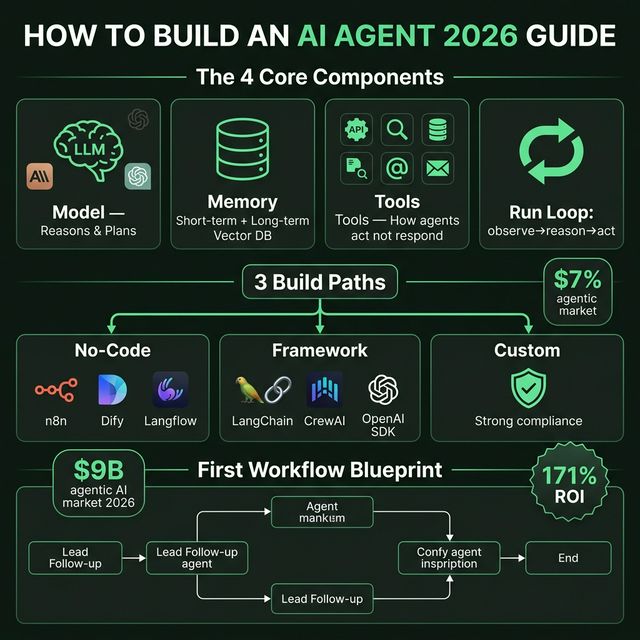
Hướng Dẫn Xây Dựng AI Agent 2026: 4 Components, 3 Build Paths, và Workflow Đầu Tiên Để Ship
Thị trường agentic AI vượt $9 tỷ năm 2026 với ROI trung bình 171%. Nhưng phần lớn người mới build agent sai — họ automating những thứ sai, quá phức tạp, quá sớm. Hướng dẫn thực tế: 4 components của mọi agent, 3 build paths (no-code/framework/custom), và blueprint workflow đầu tiên để ship trong 7 ngày.
Mọi Người Nói Về AI Agents. Nhưng Phần Lớn Không Biết Cách Build.
Số liệu 2026 khó bỏ qua:
- Thị trường agentic AI vượt $9 tỷ
- Gartner dự báo 40% enterprise applications sẽ embed AI agents cuối năm 2026 (từ dưới 5% năm 2025)
- ROI trung bình: 171% — US enterprises đạt 192%
- Con số cao hơn traditional automation 3 lần (Deloitte 2026 State of AI in Enterprise)
Nhưng đây không phải hướng dẫn về why agents. Đây là hướng dẫn về how — với 4 decisions cụ thể bạn cần đưa ra trước khi viết dòng code đầu tiên.
2026 Khác 2024 Ra Sao?
Năm 2024, "AI agent" thường nghĩa là: chatbot connect với vài tools, chạy trong Streamlit, restart khi fail.
Năm 2026:
- Runtime có durability (Dapr Agents v1.0 GA, vừa release 23/3/2026)
- MCP standardize tool interfaces — agents có thể talk to tools từ vendors khác
- Model routing là standard — cheap model cho simple tasks, expensive model cho complex reasoning
- Agent Teams (Claude Code) và parallel agents (Windsurf Wave 13) là production-ready
Điều này có nghĩa: barrier to build đã giảm, nhưng barrier to build well đã tăng. Có nhiều options hơn, có nhiều trade-offs hơn để navigate.
4 Components Của Mọi AI Agent
Mọi agent, mọi use case — đều có 4 thứ này.
1. Model (Brain)
LLM làm reasoning, planning, và quyết định gì xảy ra tiếp theo. Năm 2026: Claude Sonnet 4.6, GPT-5.x mini, Gemini 2.5 Flash là top choices cho production. Lựa chọn model ảnh hưởng:
- Reasoning quality
- Latency
- Cost per token
- Context window size
2. Memory
Những gì agent biết và nhớ. Hai loại:
- Short-term (in-context): Conversation history trong current session
- Long-term (external): Vector database hoặc SQL store persist across sessions
Agent không có long-term memory → bắt đầu từ zero mỗi lần. Đối với workflows cần personalization hoặc learning over time, long-term memory là required.
3. Tools
Đây là điều biến chatbot thành agent. APIs, web search, databases, file systems, email, Slack, calendar — bất kỳ external system nào agent có thể call.
Không có tools → agent chỉ có thể generate text, không thể act. Tools là nguồn gốc của cả value và risk.
4. Run Loop (Logic Engine)
Engine thực thi. Chạy cho đến khi goal đạt được hoặc stop condition fires:
while not done and steps < limit:
    observe → reason → act → check
Loop này là toàn bộ game. Mọi thứ khác là configuration. Stop condition và step limit quan trọng như model choice — không có chúng, agent có thể chạy vô hạn và tốn hết budget.
Điều Quan Trọng Nhất Không Ai Nói Với Bạn
Nếu task mất 5 phút và bạn làm 1 lần/tuần — bạn không cần agent. Đó là waste của công sức và risk exposure.
Rule: Build agent cho workflows high-frequency, repeatable, và measurable.
Highest-value first agents:
- Task bạn làm manually hàng ngày
- Slightly boring, completely repetitive
- Mất lâu hơn nó phải mất
Không phải: Complex, one-off analysis. Creative tasks requiring judgment. High-stakes decisions cần human accountability.
3 Build Paths: Pick Your Starting Point
Path 1: No-Code
Tools: n8n, Dify, Langflow, Make
Khi nào nên chọn:
- Bạn không phải developer
- Prototype nhanh để validate use case
- Workflow đơn giản (linear, predictable)
- Team có skill về business processes, không phải code
Trade-offs:
- ✅ Fastest to start
- ✅ Visual, collaborative
- ❌ Limits flexibility cho complex logic
- ❌ Harder to debug edge cases
- ❌ Vendor lock-in potential
Estimate: 1-3 ngày để có working prototype
Path 2: Framework
Tools: LangChain, CrewAI, OpenAI Agents SDK, LlamaIndex
Khi nào nên chọn:
- Developer background, comfortable với Python
- Need custom logic không có trên no-code tools
- Multi-agent workflows (research + synthesize + publish)
- Plan scale sang production (framework có better testing tools)
Trade-offs:
- ✅ Flexible, testable
- ✅ Large community và documentation
- ❌ More setup time vs no-code
- ❌ Learning curve cho framework-specific patterns
Estimate: 1-2 tuần cho working production pilot
Path 3: Custom
Khi nào nên chọn:
- Compliance/security requirements không allow third-party orchestration
- Existing infrastructure không support public frameworks
- Team có strong engineering bandwidth
- Need complete control over every layer
Trade-offs:
- ✅ Maximum control
- ✅ No external dependencies
- ❌ Highest time investment
- ❌ Re-inventing solved problems
Estimate: Weeks to months
Blueprint: First Workflow
Rule "First Workflow": Chọn task mà nếu agent làm wrong, consequences là manageable (không phải catastrophic).
Example: Lead Follow-Up Agent
Trigger: New lead submits form on website

Step 1 — Enrich (Tool: Clearbit/Apollo API)
  Input: email
  Output: company, role, company_size, tech_stack

Step 2 — Qualify (Model reasoning)
  Input: enriched data
  Output: score (hot/warm/cold) + reasoning

Step 3 — Draft outreach (Model)
  Input: enriched data + score + template
  Output: personalized email draft

Step 4 — Human review gate
  → PAUSE: send draft to sales rep for approval
  → Human approves/edits/rejects

Step 5 — Send (Tool: email API)
  Output: sent confirmation + CRM log
Tại sao đây là good first workflow:
- High-frequency (multiple leads/day)
- Measurable (reply rate, meeting booked rate)
- Human-in-the-loop at high-risk step (send)
- Reversible (draft review before send)
- Clear success metric ngay từ đầu
Guardrails Không Được Bỏ Qua
Human-in-the-Loop Points
Không phải mọi step cần human review — nhưng mọi workflow cần ít nhất 1 human checkpoint trước high-stakes action (send email, post publicly, make payment, delete data).
Stop Conditions
# Mandatory stop conditions
MAX_STEPS = 50          # Prevent infinite loops
MAX_COST_USD = 2.00     # Budget cap per run
TIMEOUT_MINUTES = 10    # Wall clock limit
Thiếu stop conditions → agent chạy vô hạn → surprise bill.
Quality Check
Sau mỗi major step, check output quality:
- Is output format correct?
- Are required fields present?
- Does content pass basic sanity checks?
Cheap heuristic checks ngăn bad output lan xuống downstream steps.
Cost & Reliability Checklist
- Token usage per run measured — biết cost trước khi run production
- Retry logic cho external API calls (3x với exponential backoff)
- Budget cap per workflow run
- Quality check sau mỗi major step
- Human gate trước irreversible actions
- Logging cho mỗi step (inputs, outputs, latency, cost)
- Failure alerting — ai nhận thông báo khi agent fail?
- Test với intentional failures trước khi go live
Scale-Up Playbook (Sau First Workflow)
Sau khi first workflow chạy ổn (1-2 tuần):
1. Add memory Nếu agent cần personalization hoặc context từ previous runs → thêm vector DB (Pinecone, Weaviate, Chroma). Start với simplest integration trước.
2. Add tools Identify bottlenecks nơi agent phải "guess" vì thiếu data → thêm tool (API, DB query, web search) để cung cấp data đó.
3. Add monitoring
- Dashboard hiển thị: runs/day, success rate, avg cost, avg latency
- Alerting khi success rate drops below threshold
- Weekly review của failed runs để identify patterns
4. Expand scope Sau khi first workflow reliable → xác định next highest-value workflow trong cùng domain. Reuse components đã build.
Takeaway
AI agent không phải magic. Nó là run loop + model + tools + memory — và bạn cần quyết định mỗi thứ một cách có chủ ý.
9 trong 10 teams build agent sai vì họ bắt đầu với complexity — multi-agent, custom runtimes, phức tạp orchestration. Đúng approach: bắt đầu với 1 workflow đơn giản, đo kết quả, scale từ evidence.
CTA: Chọn 1 task hàng ngày hiện tại bạn làm manually. Build minimal agent trong 7 ngày — no-code nếu non-developer, framework nếu developer. Đo: thời gian tiết kiệm + failure rate + cost. Từ đó quyết định có nên tiếp tục không.
Nguồn: How to Build an AI Agent: Complete Guide 2026 — The AI Corner; Gartner & Deloitte 2026 AI enterprise reports