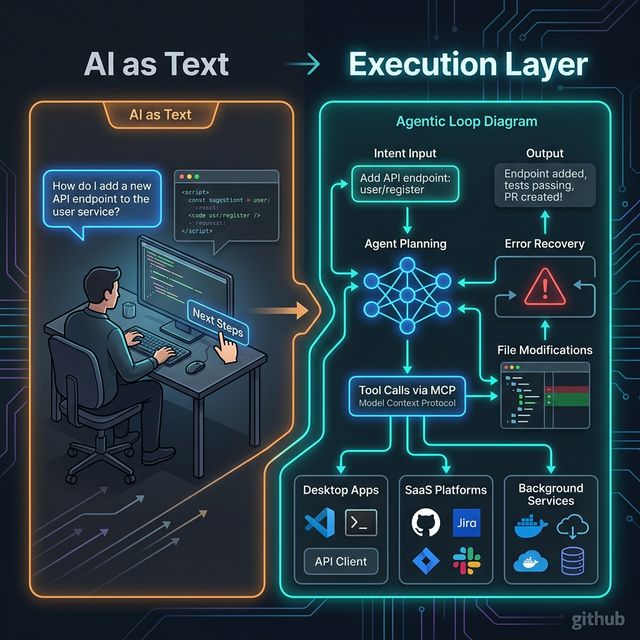
GitHub Copilot SDK: Kỷ Nguyên "AI Là Text" Đã Kết Thúc — Execution Là Interface Mới
GitHub Copilot SDK cho phép nhúng planning và execution layer của Copilot trực tiếp vào ứng dụng của bạn — không phải qua chat box, mà qua agentic execution loops chạy như infrastructure. Đây là shift kiến trúc quan trọng nhất của AI apps trong 2026.
TL;DR
GitHub Copilot SDK (2026) không phải chatbot mới — nó expose planning và execution layer đằng sau Copilot CLI cho developers nhúng trực tiếp vào applications. Shift này có nghĩa: AI không còn là text box bên cạnh product của bạn, mà là execution infrastructure chạy bên trong product đó.
Hãy thành thật: pattern AI quen thuộc nhất hiện nay là — user gõ câu hỏi, AI trả về text, human đọc và manually quyết định bước tiếp theo.
Pattern này works với câu hỏi đơn giản. Nhưng khi bạn muốn AI thực sự làm việc — explore một codebase, plan required steps, modify files, run commands, recover from failures — text response không còn đủ.
GitHub gọi shift này là: "The era of 'AI as text' is over. Execution is the new interface."
GitHub Copilot SDK Là Gì?
Từ GitHub Blog:
"The GitHub Copilot SDK makes those execution capabilities accessible as a programmable layer. Teams can focus on defining what their software should accomplish, rather than rebuilding how orchestration works every time they introduce AI."
SDK này expose planning/execution layer đằng sau GitHub Copilot CLI — cho phép developers nhúng capabilities này vào bất kỳ application nào. Không phải chỉ IDE, không phải chỉ CLI — mà bất kỳ surface nào có thể trigger logic.
Từ AI-as-text (human manually quyết định) sang execution layer (agent plan, act, recover)
3 Architectural Patterns Quan Trọng
Pattern 1: Delegate Multi-Step Work to Agents
Scripts và glue code là default của automation — nhưng chúng brittle. Khi workflow depends on context, thay đổi mid-run, hoặc cần error recovery, scripts yêu cầu hard-code edge cases hoặc xây homegrown orchestration layer.
Với Copilot SDK, bạn delegate intent thay vì encode fixed steps:
Ví dụ: App của bạn expose action "Prepare this repository for release."
Thay vì define từng bước thủ công, bạn pass intent và constraints. Agent tự:
- Explore repository
- Plan required steps
- Modify files
- Run commands
- Adapt nếu có lỗi — không crash, không dừng lại
Tất cả trong defined boundaries bạn set.
Tại sao điều này quan trọng: Khi systems scale, fixed workflows break down. Agentic execution cho phép software adapt trong khi vẫn constrained và observable — không cần rebuild orchestration từ đầu mỗi lần thêm AI.
Pattern 2: Ground Execution in Structured Runtime Context
Nhiều teams đang cố nhồi nhiều behavior hơn vào prompts. Nhưng encoding system logic trong text khiến workflows khó test, khó reason về, và khó evolve. Prompts trở thành brittle substitutes cho structured system integration.
Với Copilot SDK, context trở thành structured và composable:
Thay vì:
"System context: We use microservices. Auth service owns /api/auth.
 Payments service owns /api/payments. Historical decision: we use
 PostgreSQL not MongoDB because..."  [500 words of context stuffed into prompt]

Thay thế bằng:
agent.addTool("get_service_ownership", queryServiceRegistry)
agent.addTool("get_historical_decisions", queryDecisionLog)
agent.addTool("get_dependency_graph", queryDependencyDB)
Agent access structured context tại runtime thay vì nhận dump text không có cấu trúc. Định nghĩa domain-specific tools hoặc agent skills, expose qua Model Context Protocol (MCP), để execution engine retrieve context khi cần.
Ví dụ một internal agent:
- Query service ownership
- Pull historical decision records
- Check dependency graphs
- Reference internal APIs
- Act under defined safety constraints
Tại sao điều này quan trọng: Reliable AI workflows depend on structured, permissioned context. MCP cung cấp plumbing giữ agentic execution grounded trong real tools và real data, không phải guesswork embedded trong prompts.
Pattern 3: Embed Execution Outside the IDE
Hầu hết AI tooling hiện tại assume meaningful work happens inside IDE. Nhưng modern software ecosystems extends well beyond an editor.
Với Copilot SDK, execution trở thành application-layer capability:
Teams muốn agentic capabilities trong:
- Desktop applications — off-screen background processing
- Internal operational tools — support ticket triage, incident resolution
- Background services — scheduled automation, event-driven workflows
- SaaS platforms — built-in AI for end users
- Event-driven systems — trigger on file change, deployment, user action
System của bạn listen cho event — file change, deployment trigger, user action — và invoke Copilot programmatically. Planning/execution loop chạy inside your product, không phải trong separate interface hay developer tool.
Khi execution được embed vào application: AI không còn là helper trong side window. Nó trở thành infrastructure — available ở mọi nơi software của bạn chạy.
Tại Sao "AI As Text" Không Còn Đủ?
| Dimension | AI as Text | Execution Layer |
|---|---|---|
| Output | Text response | Actual changes (files, PRs, configs) |
| Multi-step | Human manually chains | Agent plans và executes |
| Error handling | User re-prompts | Agent adapts và recovers |
| Context | Stuffed in prompt | Retrieved from real systems via tools |
| Integration | Copy-paste outputs | Native integration with systems |
| Embedding | Chat box cạnh app | Infrastructure inside app |
5 Thứ Builders Nên Học Ngay Cả Khi Không Dùng Copilot SDK
- Intent-based orchestration: Define what bạn muốn achieve, không phải how từng bước một — để execution engine xử lý context
- Runtime tool access thay vì prompt stuffing: Build tools cụ thể cho context retrieval thay vì nhét hết vào system prompt
- Structured context và schemas: Domain rules, API schemas, ownership data — expose qua structured interface, không phải text
- Constraint-driven execution: Boundaries và permissions xác định trust domain, không phải prompt instructions
- Event-triggered workflows: Bất cứ điều gì trigger logic trong app đều có thể trigger agentic execution
Build vs Buy: Câu Hỏi Quan Trọng
Trước khi chọn SDK hoặc framework, hãy hỏi:
Dùng hosted orchestration engine khi:
- Không có internal infra để host execution loop
- Muốn trust domain và audit logging out-of-the-box
- Team chưa có kinh nghiệm với agentic architecture
Dùng embedded execution SDK (như Copilot SDK) khi:
- Cần deep integration với existing application architecture
- Muốn control hoàn toàn tools, memory, retries, logging, permissions
- Execution là core feature của product, không phải add-on
Dùng framework (LangGraph/CrewAI/n8n) khi:
- Cần multi-agent coordination phức tạp
- Muốn visual workflow builder
- Team prefer Python/JavaScript ecosystem hơn SDK integration
Use Cases Thực Tế Cho Builders
- AI-native release automation: Từ "chuẩn bị release" đến PRs, changelogs, notifications — không phải script, mà là intent delegation
- Support ticket triage + action chains: Classify → lookup → draft response → escalate if needed — không cần human sau mỗi bước
- Content ops với human review gates: Generate → review gate → publish — agent xử lý generation, human approve ở checkpoints
- Devtool automation inside product: Events trong SaaS trigger agentic workflows ngay bên trong product experience
Takeaway
"If your application can trigger logic, it can trigger agentic execution."
"Execution is the new interface" không chỉ là branding — đây là product architecture shift. Winners sẽ là teams design AI systems xung quanh tools, context, constraints, và outcomes — không phải xung quanh chat boxes và text responses.
Audit ngay một AI feature hiện có của bạn: Nó có nên stay as chat, hay nên trở thành executable workflow?