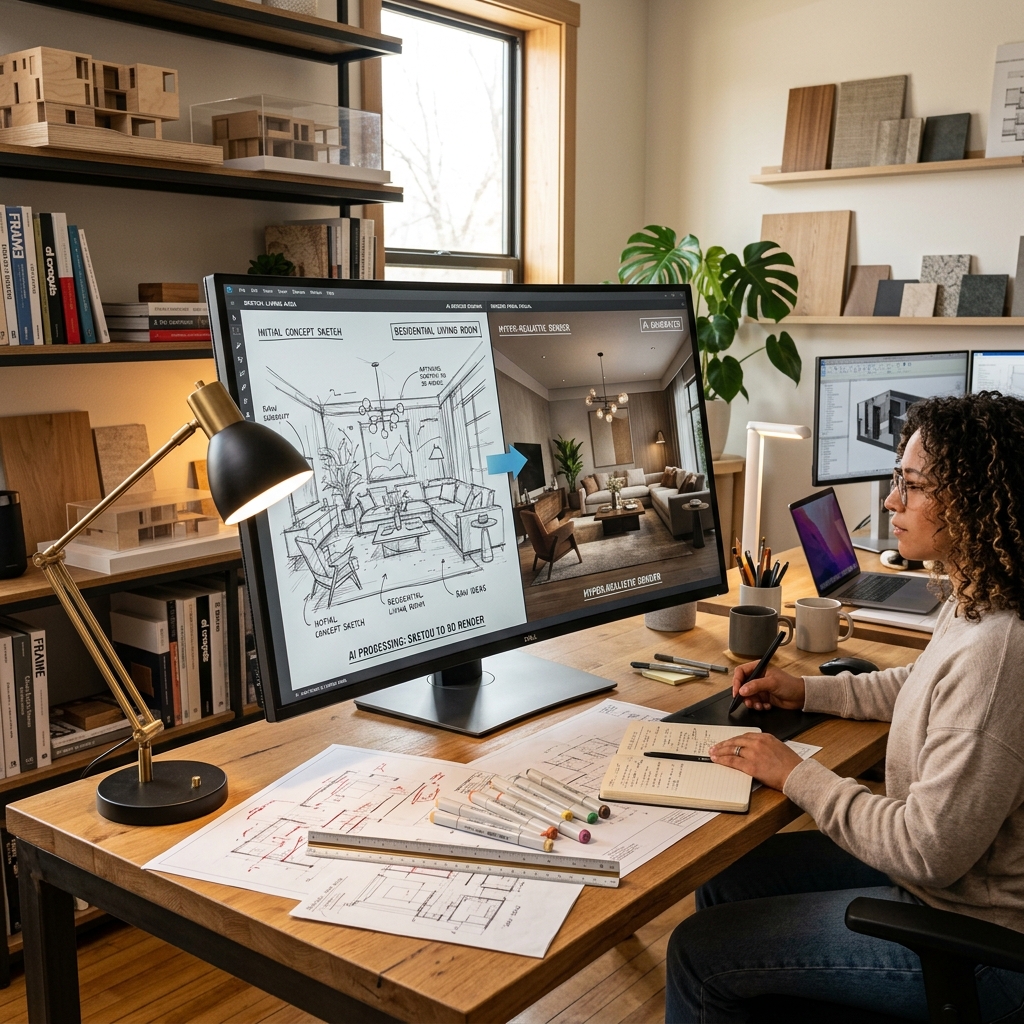
Practical AI Application: Architects & Interior Designers
Client hates the 3D render and demands a redesign? Ditch grueling overnight 3D Max grinding. Learn how Krea AI and PromeAI convert napkin sketches into photorealistic 3D concepts.
Professionals dwelling within Architecture and Interior Design continually clash against a brutal reality barrier: How do you rapidly and cost-effectively beam the "Imagination" locked inside your head into the client’s mind before committing a hundred hours into heavy technical CAD modeling?
While you suffer silently staring at a freezing SketchUp or 3Ds Max rendering progress bar through the night—only for the client to bluntly reject the aesthetic—your modern AI-equipped competitors are simultaneously generating 20 varied photorealistic 3D iterations to close the structural pitch during the very first coffee meeting.
1. Major Bottlenecks Plaguing Design Workflows
- Grueling Rendering Costs: Heavy hardware degradation, wasted hours waiting for V-Ray/Corona computing math just to yield a single preliminary concept image.
- Client Indecisiveness: They claim they adore "Classic," yet reject your model for being "Too Old." They claim "Minimalism," but complain it feels "Empty." You endure endless revision death spirals.
- Translating Raw Line-art: Your chaotic pencil ball-point sketches are mathematically brilliant, but average commercial clients physically lack the spatial awareness required to comprehend raw grid lines.
- The Struggle of Style Mixing: Devoting literal days hunting down obscure HDRI material libraries to test-mesh Wabi-Sabi seamlessly with Industrial Modern aesthetics.
How does AI resolve this? AI unequivocally DOES NOT output final millimeter-precise CAD schematics or millwork CNC files. AI acts autonomously as an "Idea Photocopy Machine"—transmuting a messy napkin sketch into a phenomenal High-Definition photograph to CLOSE THE DEAL, after which you legally draft the actionable engineering blue-prints utilizing traditional structural logic software.
2. Absolutely Critical Toolkit For Arch/Interior
- PromeAI / Krea.ai: The unrivaled kings of structural visualization. Extremely lethal regarding "Sketch to Render" algorithms. You wildly scribble basic boxes and cylinder outlines, and the AI real-time calculates lighting physics to forge a skyscraper or bedroom topology instantly.
- Midjourney v6: The titan of preliminary Concept Conception. Possibility-mixing heavy architectural eras with extreme cinematic photorealism to the degree that clients falsely assume it's a real photograph of an already built landmark.
- ChatGPT (Vision capability): Utilized for structural layout reverse-engineering, analyzing Feng-Shui, or precisely decoding what exact style naming-convention a client’s ambiguous Pinterest reference image belongs to.
3. High-Velocity Pitching Workflows
Use-case 1: The "Design It Like This Image" Nightmare
Goal: The client texts you a blurry, heavily compressed Pinterest photo demanding an exact replica but vaguely commanding "Turn it Greenish." You haven't a clue what legitimate Design Style the photo belongs to.
Execution Flow (ChatGPT Vision & Midjourney integration):
- Copy the blurry client inspiration photo directly into ChatGPT.
- Execute data-scraping Prompt: "Assume the identity of a Senior Chief Architect. Deeply analyze this reference file and explicitly identify: The exact Architecture Style terminology, the dominant Core Color Palette, and Lighting geometry. Finally, output a direct Midjourney Prompt that 100% scientifically reconstructs this exact spatial topology."
- Extract that generated ChatGPT Prompt, deliberately inject the client's request: "... replacing the generic Sofa with an Emerald Velvet Sectional..." and trigger Midjourney to yield 4 completely fresh structural variations saving you 12 hours of manual 3D cloning.
Use-case 2: "Sketch To Render" Tabletop Deal Closing
Goal: While sitting physically opposite a hesitant client, physically sketch a raw floorplan geometry onto a paper napkin. Thirty seconds later, visually shock them with a photorealistic 3D paradigm of that napkin to secure the project deposit instantly.
PromeAI / Krea AI Pipeline:
- Scribble raw line-art denoting basic volumetric bounding boxes (walls, beds, vast windows). Capture it via phone camera.
- Push the image into the Sketch to Render terminal inside PromeAI.
- Instruct the material/texture nodes: "Modern bedroom, wide-plank walnut wooden floor, brutalist concrete accent wall, massive bay window filtering harsh morning sunlight, minimalist linen duvet."
- AI calculates 3 photorealistic iterations. Client hesitates: "Can we swap the harsh concrete for warm wooden panels?" -> Simply redefine the text input to
warm wooden walland display the new reality 5 seconds later without ever touching a heavy 3D rendering engine.
Use-case 3: Rapid "Skin Swapping" Dilapidated Realty (Flip Concept)
Goal: A client inspects a decaying, trash-filled commercial outlet they intend to lease. Lacking a signed contract, you refuse to waste 3 free days executing full-scale 3D scans and modeling.
Workflow Paradigm (Image-to-Image execution):
- Photograph the ugly, ruined, empty room "As-Is".
- Inject it into Midjourney or specialized interior AI software, heavily clamping the Image Weight parameter so the core walls remain identical.
- Command the Architecture AI Prompt:
[Current_Room_URL_Link] Completely refurbished ultra-modern living room, ruthlessly eradicating chaotic debris. Replacing destroyed tiles with immaculate herringbone hardwood flooring, installing a colossal grey modular sofa. Brilliant volumetric natural lighting, photorealistic archviz, corona render computation, 8k resolution --ar 16:9 --vw 0.5
Why it crushes objections: The client will experience severe psychological shock witnessing the pure inherent Potential of the filthy property, magically sterilized and styled by Artificial Intelligence. It elevates their purchase/design anxiety to immediate excitement.
4. Unorthodox Tricks True Architects Exploit
- The Material Vocabulary Mandate: The lethal difference between amateur renders and Archviz supremacy lies within texture phrasing. Never prompt an AI utilizing general terms like "wooden table." Explicitly lock the light reflection behavior: “matte dark walnut wood table, highly polished reflective Italian marble floor, brushed raw industrial steel lamp fixture”.
- Lighting Controls 80% Of Spatial Value: Architecture breathes through light physics. Midjourney is profoundly reactive towards academic rendering keywords: “Octane render engine, Unreal Engine 5, Ray tracing enabled, V-Ray, Golden hour volumetric sunlight, Soft diffused ambient shadow” preventing the image from appearing flat and plasticky.
5. The Fatal Biological Limitation of AI
[!CAUTION] Present-day Artificial Intelligence generates exceptionally gorgeous conceptual art, yet remains entirely and devastatingly Scale Blind!
The AI algorithm mathematically possesses absolutely ZERO comprehension of human biological ergonomics or fundamental structural physics. It will happily render a stunning kitchen cabinet hovering totally unreachable near a 15-foot ceiling without hinges, or squeeze a massive King-sized bed merely 5 inches away from a wall, crushing human walking pathways perfectly cleanly in the image.
The Absolute Rule: NEVER hand a raw AI-generated Image off directly to brutalist construction contractors or carpenters. AI imagery is strictly restricted to "Phase 1: Pitching the Vision & Signing the Contract." Once the deal is secured, the Architect MUST manually, technically, and mathematically reconstruct the entire spatial metric utilizing AutoCAD/Revit/SketchUp to obey strict, legal human-scale logic!
If massive bloated design mega-firms are still agonizingly restricted to a 7-day turnaround timeline to furnish a decent 3D concept layout; you—an agile, solitary, AI-enhanced Architect—possess the technological firepower to obliterate their bureaucracy by locking down a client's aesthetic vision within a single afternoon!