
AI in Education: Practical Workflows to Enhance Teaching and Learning
AI is no longer just a tech gimmick—it's evolving into a 'digital teaching assistant' that helps educators save time, personalize learning, and fundamentally elevate lesson design.
AI in Education: Practical Workflows to Enhance Teaching and Learning
Artificial Intelligence (AI) is transforming how humanity works, communicates, and learns. In the pedagogical sphere, AI is not merely a technological aid; it is steadily becoming a "digital teaching assistant." It helps educators save critical time, personalize learning experiences, and elevate the standard of instructional design.
However, the efficacy of AI in education does not come from "using AI as much as possible." It stems from knowing how to delegate effectively. In other words, educators must understand how to prompt properly, establish clear educational objectives, accurately describe the classroom context, and define the necessary output formats. Only then does AI truly become a viable tool for real-world teaching.
This article focuses on the most pragmatic, ready-to-use applications of AI in education, tailored specifically for university professors, school teachers, instructional designers, and corporate trainers.
📌 TL;DR: The Core Takeaways
- The Core Value: AI in education acts as a "digital TA" that automates and accelerates pedagogical labor like generating quizzes, creating materials, and structuring slides.
- Why You Should Use It: It heavily reduces repetitive grunt work, allows personalization for varied student levels, and easily bolsters classroom interactivity.
- The Prompting Secret: Instead of a generic command, be specific: Role + Context + Target Audience + Desired Output Form + Constraints.
- The 4-Step Rule: Initiate the request → Let AI generate the draft → Provide expert critique → Instruct AI to refine and finalize.
1. What is AI in the Context of Pedagogy?
In education, AI can simply be understood as a system capable of processing user instructions and information to generate instructional outputs such as:
- Test structures and assessment questions
- Lesson plan outlines
- Presentation slides
- Study materials and glossaries
- Reading comprehension guides
- Practical examples
- Discussion scenarios
- Feedback for students
Put simply, AI does not replace the educator; it accelerates the academic and administrative tasks surrounding the act of teaching.
The pivotal point is this: AI is only useful when the instructor knows exactly what they want. Ambiguous instructions lead to generic outputs. Specific instructions allow AI to conjure results intimately aligned with the classroom's needs.
2. Why is AI Uniquely Suited for Educational Activities?
2.1. Saving Time for Educators
One of the heaviest burdens on educators is repetitive, high-volume work: drafting assesssments, compiling quizzes, designing activities, prepping slides, and tweaking materials for differentiated learning. AI drastically cuts down the time spent on these phases.
Instead of burning hours building a multiple-choice databank or summarizing a lengthy text chapter, a professor can summon a first draft in seconds. The remaining time is spent where it matters: academic verification and fine-tuning for educational goals.
2.2. Enhancing Personalized Learning
Every classroom possesses variances in foundational knowledge, learning velocity, and student needs. AI excels at generating multiple distinct permutations of content:
- A simplified variant for struggling learners.
- An advanced, complex variant for high achievers.
- A concise summary snapshot.
- A version grounded in real-world professional examples.
- A bilingual or regionally accessible version.
2.3. Boosting Interactivity and Creativity
A classroom ceases to be a one-way lecture when an educator leverages AI to brainstorm:
- Open-ended, Socratic questions.
- Debate scenarios.
- Role-playing constraints.
- Simulated case studies.
- Class discussion hooks.
2.4. Improving Accessibility to Learning Materials
AI is phenomenal at format transformation:
- Compressing long academic papers into digestible slides.
- Translating dense academic jargon into accessible language.
- Formatting professional texts into review questionnaires.
3. The Most Practical Applications of AI in Pedagogy

3.1. Generating Assessments and Question Banks
This is the lowest-hanging fruit with the most immediate ROI. AI assists educators in generating multiple-choice questions (MCQs), essay prompts, calculation problems, and scenario-based tests according to knowledge matrices.
How to apply effectively: Instead of a generic prompt like: "Generate a test for Microeconomics," write it specifically:
"Create a 15-question test for freshmen in Microeconomics, consisting of 10 theoretical 4-option MCQs and 5 short scenario-based questions focusing on supply-demand, elasticity, and market failure. Include the correct answer key with brief explanations."
Note: The educator must always verify academic accuracy, alignment with learning outcomes, the discrimination index of choices, and the language phrasing.
3.2. Designing Lesson Plans and Syllabi
AI is an incredible brainstorming partner when an instructor needs to outline learning objectives, lecture flow, classroom pacing, and homework assignments.
Real Application Example:
"Design a 90-minute lesson plan around 'Corporate Valuation' for 3rd-year finance majors. It should include 3 learning objectives, 4 main content sections, 2 group discussion activities, and 1 capstone application exercise for the end of class."
From this architectural framework, the instructor only needs to implement qualitative, stylistic tweaks.
3.3. Converting Text into Presentation Slides
Many educators have brilliant subject-matter knowledge but lose hours formatting that content into concise, presentable slides. AI can segment ideas, formulate headings, and compress key points.
Real Application Example:
"Convert the following textbook text into an 8-slide presentation for a university lecture. Each slide must contain a title and 3-5 key bullet points. The tone should be concise and optimized for live verbal delivery."
Note: AI excels at structure, but the speaker must ensure the slides aren't overly text-heavy and that they align with the verbal pacing.
3.4. Compiling Student Study Materials
For courses burdened with abstract concepts (economics, finance, law, philosophy), AI acts as a translation layer, turning academic rigidity into digestible student-friendly terminology.
Example:
"Explain the concept of 'Cost of Capital' in simple, colloquial language meant for a first-year undergraduate student. Provide 2 highly relatable, real-world corporate examples."
3.5. Assisting with Reading Comprehension and Analysis
A ubiquitous challenge in higher education is that students read a paper but fail to extract the vital thesis. AI helps educators generate a guided reading framework.
Usage:
"Create 6 guided reading comprehension questions for this attached research paper. Focus strictly on defining the core concept, evaluating the research methodology, analyzing the results, and exploring practical applications."
3.6. Creating Interactive Simulations and Case Studies
This application is perfect for competency-based education, active learning models, and applied sciences requiring case resolutions.
Example:
"Create a simulated role-playing scenario where a management student acts as a project leader facing a severe interpersonal conflict within a remote team. Append 4 critical thinking questions to be discussed after the simulation."
4. How Educators Must Prompt for High-Quality AI Outputs
The foundational law of AI interaction: The quality of the output is entirely dependent on the quality of the structural input.
A highly effective pedagogical prompt generally contains these elements:
- Define the Task: State exactly what the engine must do (draft a quiz, build a syllabus, summarize a paper).
- Set the Persona/Context: "Assume the role of an MBA professor," or "for a synchronized 80-minute online session."
- Identify the Target Audience: State their reading level, academic major, and baseline knowledge.
- Specify Output Formatting: "Format as a Markdown table," "Provide 4 options per question," "Split into 6 slides."
- Set Constraints & Rules: "Do not use overly dense academic jargon," "Use localized examples," "Keep under 500 words."
- Provide Examples (Few-Shot Prompting): Feed the AI a format you like so it can mimic the stylistic structure.
5. The 4-Step Human-AI Collaborative Loop
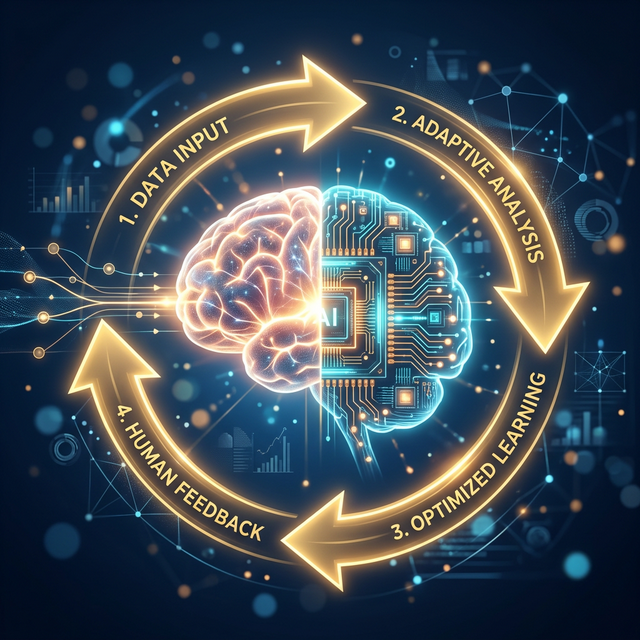
To make AI genuinely powerful, educators should adopt this 4-step cyclical workflow:
- Step 1: Initiate: Cast the initial, well-structured prompt.
- Step 2: Generate Draft: Let the AI construct the skeletal blueprint and primary content.
- Step 3: Expert Critique: The educator evaluates the draft through a professional lens (Is it too vague? Is the tone wrong? Are the examples culturally irrelevant?).
- Step 4: Refine and Instruct: Re-prompt the AI based on the critique. "Make the third section much shorter," "Change the examples to modern software companies," "Increase the academic rigor of the essay prompt."
This represents the smartest approach to AI: Do not treat AI as the source of the final answer; treat it as an elite partner for developing high-quality drafts.
6. Crucial Principles When Integrating AI into Pedagogy
- AI Cannot Replace Expertise: The accountability for educational morality, factual verification, and outcome achievement always remains with the human educator.
- Specificity is Power: The clearer your visual imagination of the output, the faster AI hits the mark. Vague prompts invite rambling hallucinations.
- Verify Accuracy Vigilantly: AI models can suffer from hallucinations, confidently citing fake statistics or misinterpreting nuanced educational theories. Never copy-paste blindly.
- Use AI for the 'Heavy Lifting': The most sustainable way to use AI is to deploy it against manual, structural friction—outlining, structuring, summarizing, and data conversion.
7. Conclusion
AI is breaking open a new frontier for education: shifting from a sterile technical tool to a cognitive partner in instructional design, assessment construction, and user-experience enhancement for learning.
The greatest value proposition of AI in education does not lie in its ability to generate content at breakneck speed. It lies in its potential to help educators work smarter, personalize deeper, and teach with more creativity. When harmonizing an instructor's academic identity with the rapid synthesis powers of AI, classrooms become vastly more organized, engaging, and highly effective.
In the fast-approaching future, the competency to orchestrate AI will no longer be an optional side-skill; it will be a baseline occupational standard for modern educators. If you take your pedagogical impact seriously, start experimenting by automating your smallest, most tedious tasks today.