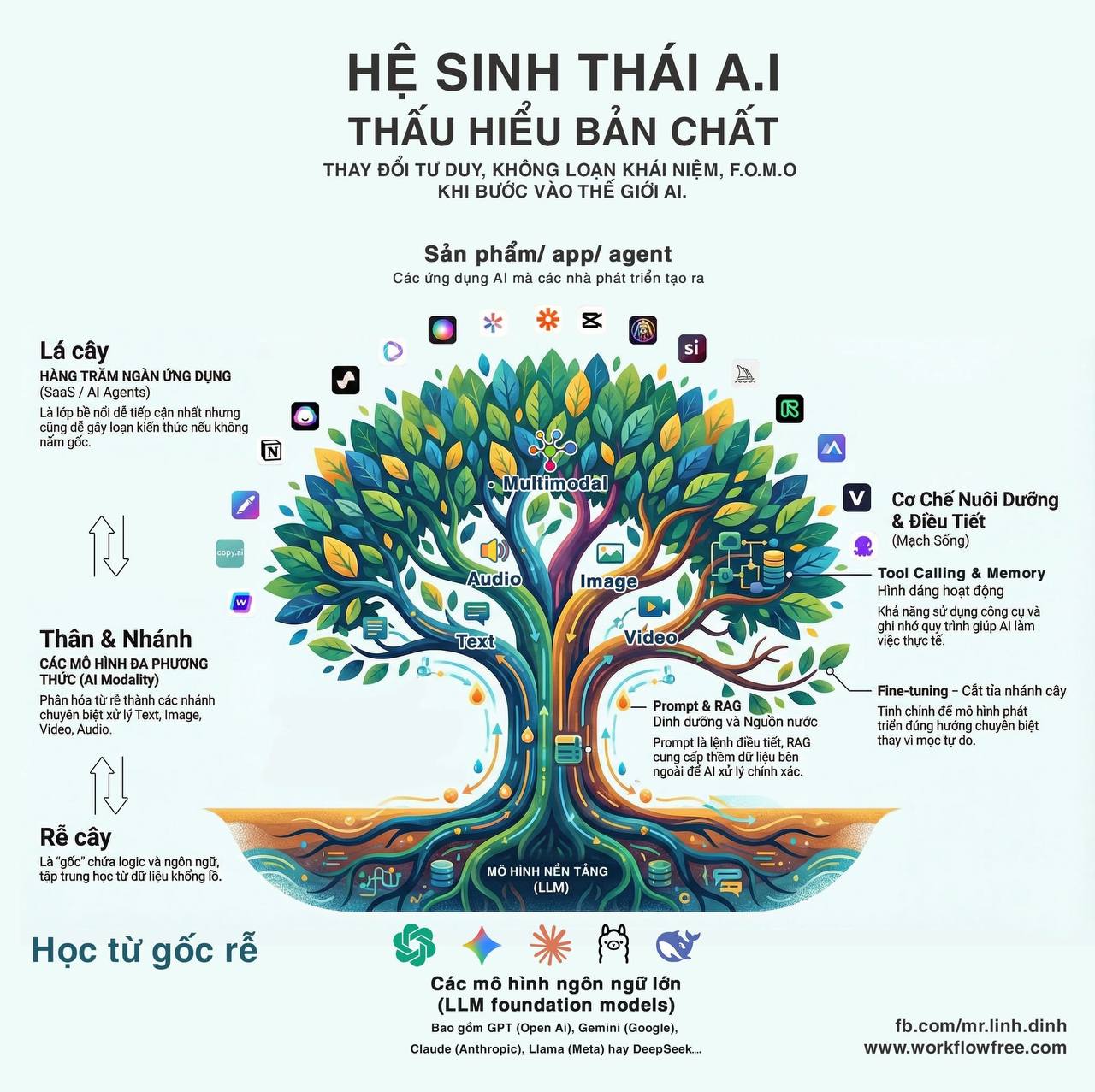
Understanding AI Through the 'Great Tree' Model — No More Concept Overload, No More FOMO (Part 1)
Overwhelmed by new AI tools every day? This article uses the 'AI Great Tree' model to help you understand the fundamentals: Roots (LLMs), Trunk (Modality), Leaves (Apps/Agents) — plus the mechanisms that connect them (Prompt, RAG, Fine-tuning). After reading, you'll know exactly where you stand and where to start.
Are You Feeling "Lost" in the World of AI?
A year ago, when many of us first started seriously exploring AI, the first feeling was F.O.M.O (Fear Of Missing Out).
Every day: using ChatGPT to write content, Google to generate images, then installing Luma, Kling, Sora... But looking back, it was all just chasing leaves without understanding the roots. Today a new technology appears, tomorrow another one breaks yesterday's knowledge. It felt endless.
If you're also struggling with where to start — this article is for you.
After reading, you will:
- Understand how AI works — through a single mental model.
- Know which layer of the ecosystem you're currently at.
- Know exactly where to begin so you never feel lost again.
The "AI Great Tree" Model 🌳
Looking at the big picture of the AI world in 2026, the entire AI ecosystem can be understood through the image of a great tree — with 3 main parts:
| Part | AI Equivalent | Count |
|---|---|---|
| 🌱 Roots | LLM Foundation Models | Under 10 major models |
| 🪵 Trunk & Branches | Modality (Text, Image, Video, Audio) | ~50 major branches |
| 🍃 Leaves | Apps, SaaS, AI Agents | Hundreds of thousands |
Understanding these 3 layers gives you the map to never get lost again.
🌱 Roots — LLM Foundation Models
The roots are the Large Language Models (LLMs) — the foundation from which the entire AI ecosystem grows.
Currently, only fewer than 10 models truly have significant influence in the AI world:
| Model | Company |
|---|---|
| GPT | OpenAI |
| Gemini | |
| Claude | Anthropic |
| Llama | Meta |
| DeepSeek | DeepSeek |
| Mistral | Mistral AI |
| Grok | xAI |
This is where the real foundational processes happen:
Machine Learning — How Does a Machine "Learn"?
Machine Learning is the dominant branch powering ~90% of all AI Agents today. Instead of humans writing explicit rules, the machine learns from data to discover patterns on its own.
Simple analogy:
It's like teaching a child math. You don't give them the formula right away. Instead, you show many specific examples:
- 1 stick + 1 stick = 2 sticks
- 1 chicken + 1 chicken = 2 chickens
- 1 cat + 1 dog = 2 animals
The child gradually recognizes the pattern: 1 + 1 = 2.
Machine Learning works the same way. The machine processes a massive amount of data to form a mathematical model that predicts: "1 + 1" → the most likely result is "2". It doesn't "know" 1+1=2 the way humans know it — it knows that "2" has the highest probability based on all the data it has seen.
Pretraining — The "Reading Phase" Before Starting Work
Pretraining is a part of Machine Learning — the phase where the model absorbs an enormous amount of general knowledge before performing any specific task.
Analogy:
A new employee joins a company. You don't assign work immediately. First, they read:
- Job descriptions
- Employee handbooks
- Standard operating procedures
- Brand guidelines
No actual work yet — the core mission is to understand language, the world, and basic logic.
The data fed into pretraining amounts to trillions of tokens (a token is the smallest unit AI uses to read, understand, and generate data).
🪵 Trunk & Branches — Modality
From the LLM roots, the system branches out into different modalities — each branch specializing in processing a specific type of data:
| Modality | Example Products |
|---|---|
| Text | GPT, Gemini, Claude |
| Image | DALL·E, Imagen, FLUX, Seed Dream |
| Video | Sora, Veo, Kling |
| Audio | Whisper, MusicLM |
| Multimodal | Combines all modalities above |
Multimodal means the model can process multiple data types simultaneously:
- Image + Question → AI answers
- Video + Request → AI analyzes
- Voice + Image → AI understands full context
The number of major branches at this level is roughly under 50. This is the second most important layer to understand.
🍃 Leaves — AI Applications (Apps / SaaS / Agents)
This is the layer that most people encounter first — and the one that causes the most confusion.
Leaves = AI products/apps created by developers. The current count has reached hundreds of thousands, with new ones appearing every single day.
Types include:
- Automated video generation apps
- Customer service chatbots
- AI Sales Assistants
- AI Image/Video Editors
- Automation AI Agents (n8n, Make, Zapier)
- And thousands of other SaaS products...
The key insight: All these leaves are marketed professionally with flashy features, but ultimately, they all share the same few dozen Roots and Branches underneath.
⚠️ If you keep focusing on the "Leaf" layer, you'll quickly drown in information overload and endlessly chase the next shiny tool. This is the exact trap that keeps beginners confused about AI fundamentals.
🔗 Lifeblood of the Tree — The Connecting Mechanisms
If Roots are the foundation, Branches are the growth paths, and Leaves are the products — then the lifeblood connecting the entire tree consists of these mechanisms:
Group 1: Regulatory Mechanisms (Nutrition)
| Mechanism | Tree Analogy | Explanation |
|---|---|---|
| Prompt | Nutrient regulation | The instruction/question you give AI. Good prompt = right nutrients = quality results. |
| RAG | Additional nutrition & water supply | Retrieval-Augmented Generation — giving AI access to external data sources for more accurate responses. |
| Fine-tuning | Pruning branches | Adjusting the model to grow in the direction you want, instead of growing wildly. |
Group 2: Operational Mechanisms (Tree Shape)
| Mechanism | Tree Analogy | Explanation |
|---|---|---|
| Tool Calling | Shaping tools | Allowing AI to call external tools (web search, database access, sending emails...) |
| Memory | Guide books | Memory helps AI retain context across multiple sessions. |
| Workflow | Pruning process | Setting up multi-step processes for AI to execute complex tasks in sequence. |
👉 Part 2 will explain each of these mechanisms in detail with real-world examples, helping you apply them to your daily work.
Summary: Which Layer Are You At?
🍃 Leaves (Apps/Agents)      ← Most people are here
                                 Easy to access but easy to get overwhelmed

🪵 Trunk & Branches (Modality) ← Understanding this = choosing the right tool
                                 Text, Image, Video, Audio, Multimodal

🌱 Roots (LLM)               ← Understanding this = understanding AI fundamentals
                                 GPT, Gemini, Claude, Llama, DeepSeek

🔗 Lifeblood (Mechanisms)    ← Mastering this = mastering AI
                                 Prompt, RAG, Fine-tuning, Tool Calling
Practical advice:
- Don't try to chase every new AI app (Leaf layer). They will keep changing.
- Invest your time understanding the Roots (how LLMs work) and the Lifeblood (Prompt, RAG).
- Once you understand the foundation, you can evaluate any new AI application that appears — instead of being overwhelmed by FOMO.
"Artificial Intelligence (AI) isn't as hard as you think. Mastering AI is within your reach."
Coming in Part 2: Detailed explanations of the regulatory mechanisms (Prompt, RAG, Fine-tuning) and operational mechanisms (Tool Calling, Memory, Workflow) — with practical, visual examples for beginners.