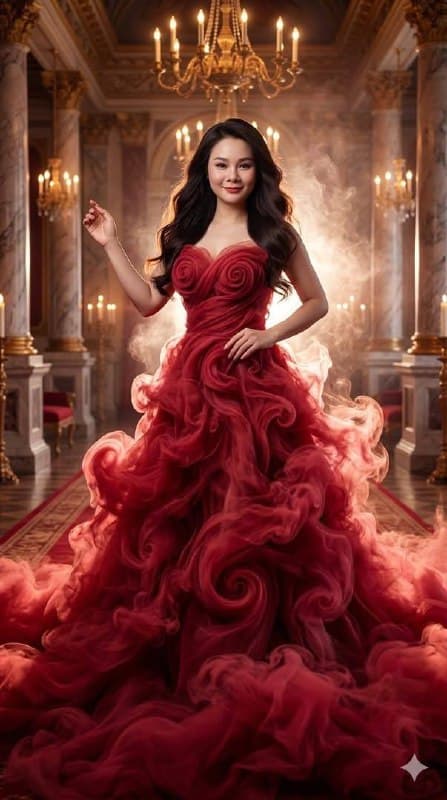
The Smoke Gown Goddess: Surreal Fashion Art Prompt
Transform a standard portrait into a surreal masterpiece by preserving 100% of the subject's original facial identity while constructing an entire dramatic gown out of vivid crimson smoke.
A very common objective for graphic designers navigating AI workflows is: How can I preserve the exact 100% facial identity of a real person, but place them into a surreal, mythical context where their clothing is made entirely out of elemental matter instead of normal fabric?
The "Smoke Gown" prompt completely solves this problem. It's an incredible display of structural prompt engineering intersecting with artistic creativity.
📸 Reference & Result Analysis
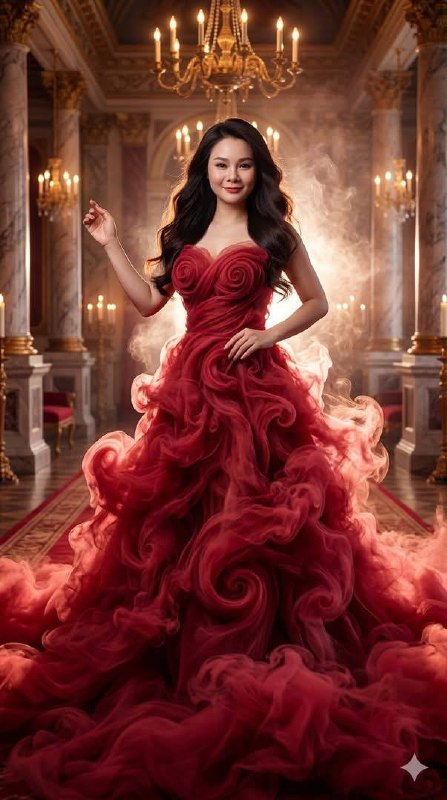
The Result: The real face is locked in place, but the rest of her body has been transformed into Surreal Fashion Art.
The generated image beautifully demonstrates a perfect decoupling between Identity Control (retaining the real person's face) and Environmental Control (letting the AI hallucinate extreme physics and styling).
✍️ The Master Prompt
Here is the exact structured prompt you can copy and deploy on any modern AI generation engine that supports image references (like Midjourney's --cref, or Stable Diffusion with FaceID ControlNet):
Use my uploaded reference photo. Preserve the original face with 100% identity accuracy while keeping the facial identity clearly recognizable.

Hair: long elegant hair with soft waves cascading down the shoulders, gently moving as if influenced by the subtle air currents shaping the smoke gown.

A hyper-realistic 8K vertical portrait (9:16), full body composition, photographed at eye level using a professional 105mm portrait lens.

The subject appears as a regal woman whose entire gown is constructed purely from dense crimson smoke. The dress is completely made of swirling vapor with no fabric present.

Tightly spiraling crimson smoke currents wrap around the torso forming a structured bodice. From the waist downward, powerful plumes of red smoke expand outward into a dramatic ballroom gown silhouette. The skirt is composed of layered smoke waves, swirling eddies, vapor filaments, and rolling turbulence patterns that clearly reveal the dress structure made entirely from smoke.

Pose: strong royal pose. The subject stands tall with one arm slightly raised outward while the other hand rests near the waist. Chin slightly lifted with a confident elegant smile directed toward the camera.

Environment: a vast royal palace hall with towering marble columns, giant chandeliers, red carpets across the polished floor, and rows of glowing candles lighting the ornate architecture.

Lighting: warm cinematic lighting with strong backlight shining through the crimson smoke gown, revealing its layered vapor structure.

Camera settings: Canon EOS R5, RF 105mm lens, f/2, ISO 100, shutter 1/160s, HDR capture, shallow depth of field, volumetric lighting.

Style: surreal hyper-realistic royal fashion photography.
🔍 Deconstructing the 5 Core Components
The prompt is deliberately separated into categorized blocks to orchestrate specific control over the generative AI parameters. Here is why it works so well:
1. The Ultimate Identity Directive
"Use my uploaded reference photo. Preserve the original face with 100% identity accuracy..."
This acts as a strict priority constraint. Before the AI hallucinates anything complex, it establishes the foundation rule: keep the facial markers exact to the uploaded photo.
2. Instructing Virtual Physics
"...whose entire gown is constructed purely from dense crimson smoke. The dress is completely made of swirling vapor with no fabric present."
The magic is in the negative reinforcement: no fabric present. This forces the AI to abandon rendering traditional textures (like silk or velvet) and purely commit to fluid dynamics. The prompt is highly visual, explicitly detailing the upper body as "tightly spiraling currents" and the lower skirt as "powerful plumes."
3. Creating Layers with Backlighting
"warm cinematic lighting with strong backlight shining through the crimson smoke gown, revealing its layered vapor structure."
Smoke without good lighting becomes a flat, murky blob. Calling for a strong backlight is a real-world photography trick designed to illuminate translucent elements. The backlight pierces through the vapor, separating foreground from background and exposing the internal swirling details of the smoke dress.
4. Designing Architectural Contrast
"A vast royal palace hall with towering marble columns, giant chandeliers..."
A plain studio background would be boring. Placing the "moving" subject inside a grand, static architectural space introduces stunning contrast. The rigid marble columns play powerfully against the swirling, formless chaos of the crimson smoke.
5. Locking Realism via Camera Data
"Canon EOS R5, RF 105mm lens, f/2, ISO 100, shutter 1/160s..."
If you just say "hyper-realistic," the AI often renders something that looks like an impressive 3D video game. By forcing precise EXIF equivalent data (f/2 for incredible subject separation, 105mm focal length for compression, and 1/160s shutter speed exactly fast enough to freeze the immediate smoke motion while keeping edges soft), you enforce a purely photographic render style.
🎨 Variables to Play With
With this framework in place, you can remix the core element effortlessly:
- Change the color: Swap out
crimson smokewithglowing emerald mistoriridescent neon smokeorpure white ethereal vapor. - Change the elemental matter: Instead of smoke, completely rewrite the physics by trying
constructed purely from crashing ocean waves and sea foamorcompletely made of twisting cosmic stardust and nebulas.
This structure gives you total creative freedom while firmly protecting the identity of your primary subject.