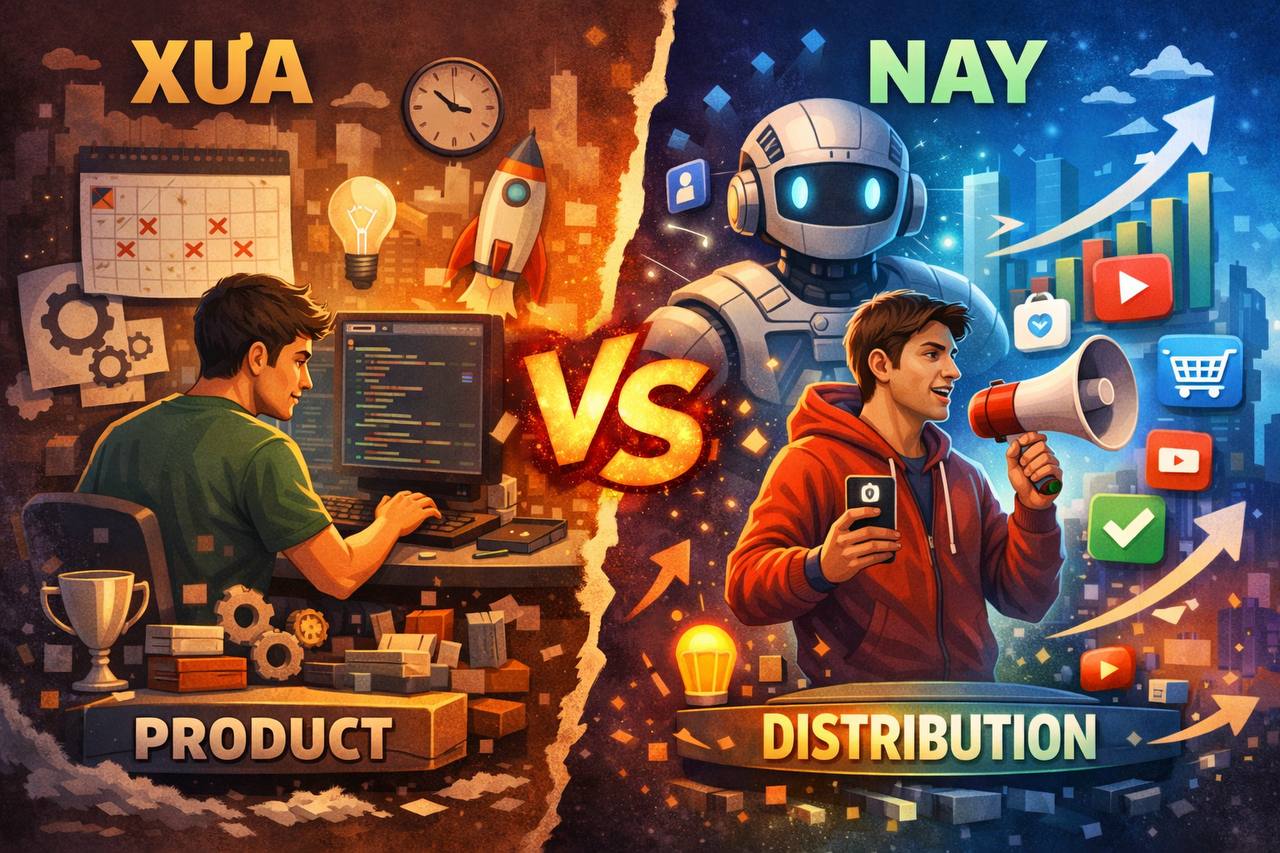
Building Products — Then and Now: AI Makes Building Easier, but Startups Still Die Just the Same
AI lets you build an MVP in weeks instead of years. But startup failure rates haven't dropped. The reason: the game has shifted from 'product game' to 'distribution game' — and most founders haven't realized it yet.
There's an interesting truth in the startup world: technology changes rapidly, but the reasons startups fail remain almost unchanged.
AI changes the speed of building. But the distribution problem remains exactly the same.
Before: Startups Died Because They Couldn't Finish Building
Looking back at the pre-generative AI era (roughly 2005–2019), building a tech startup was a long and fairly grueling journey. Teams typically followed a familiar timeline:
- A few months to find and validate an idea
- A few months to build a prototype
- Another year or more to build a complete product
In total, nearly 1–2 years just to ship a first version.
Sadly, many startups died before they ever reached the market. Not because the idea was bad. Not necessarily because founders lacked capability. Simply because resources ran out before the product was finished.
According to CB Insights, approximately 90–95% of startups fail before finding product–market fit, with many stopping during the build phase itself.
Now: Building Products Faster Than Ever
By 2025–2026, a lot has changed. With the arrival of AI and LLMs, no-code / low-code tools, vibe coding, and a wave of AI dev tools, the product-building process has been dramatically accelerated.
Today, a single person can:
- Validate an idea in a few days
- Build an MVP in a few weeks
- Even ship a finished product in a few months
What used to require a full developer team, a solo builder can now handle.
It sounds great on paper. Hence the explosion of AI courses, "make money with AI" articles everywhere, and the widespread belief that anyone can build a startup.
But when you actually try to build something and take it to market, many people discover a familiar reality:
Building the product is fast… but you're still not making money.
AI Only Changes Build Speed — Not the Nature of the Game
My view is that AI has only changed one part of the game. It accelerates the product-building phase. But what actually determines whether a startup survives is nearly unchanged.
That's Marketing and Distribution.
In the old days, startups spent 90% of their resources building the product — and many burned through everything before finishing. Today, especially for solo founders and indie hackers, the story is different:
Building the product now consumes only 5–10% of resources. Sometimes it feels like you've barely started and the product is almost done.
But immediately after, you hit a different wall: nobody knows your product exists. No traffic. No users. No distribution channel. And ultimately — no revenue.
The Same Mistake Repeated Across Generations
The pattern I see repeatedly across startups — both past and present — is that people spend too much time on the product and drastically underestimate marketing and distribution.
The reality: a great product does not sell itself.
This is one of the most common misconceptions among technical founders. We tend to believe that if the product is good enough, users will find us. But the market works the opposite way — without distribution, even a great product is easy to miss.
The Competitive Advantage in the AI Era Is No Longer Building Fast
In the AI era, competitive advantage no longer comes from who codes faster, who ships the MVP first, or who launches earliest — because everyone can do those things now.
The real advantage lies in:
- Who builds an audience
- Who generates traffic
- Who has stronger distribution channels
In other words:
The startup game is shifting from a "product game" to a "distribution game."
Maybe Think About Marketing Before Thinking About Product
Here's something worth considering: AI doesn't just help you build products faster. It also helps you create content faster, test marketing faster, build an audience faster, run growth experiments faster.
So maybe the most important question today is no longer "What product should I build?" — it's:
"Which distribution channel should I build first?"
Then figure out the product.
In many cases, this approach is significantly safer for founders.
A Final Thought
There's a website I've been following recently: startups.rip — a collection of failed startup post-mortems. Reading through those stories reveals something consistent: many startups didn't fail because their idea was bad, or because the founders lacked skill. Sometimes it was just because the timing was slightly off.
Startups, at their core, are still a game with many variables. AI helps us build faster. But to survive, startups still have to solve the original problem: how to get users.
References: Eric Ries – The Lean Startup (2011) · CB Insights – The Top 20 Reasons Startups Fail · Y Combinator Startup School – How to Build an MVP & Find Product–Market Fit