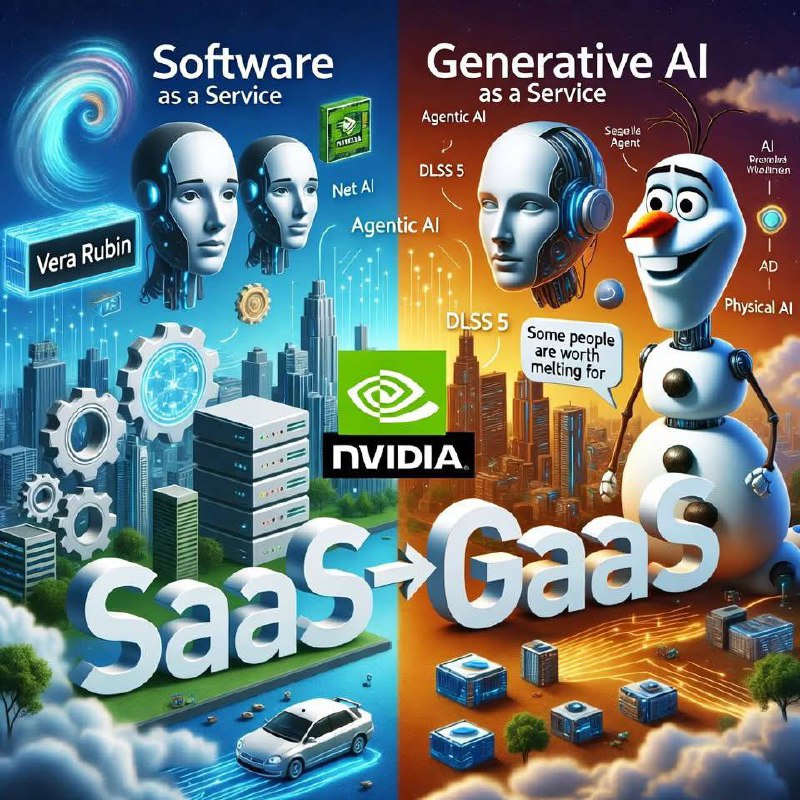
Is SaaS Dead? Jensen Huang Declares the World Is Shifting to GaaS at NVIDIA GTC 2026
At GTC 2026 keynote (March 16, 2026), Jensen Huang declared: 'Every SaaS company will become a GaaS company' — the Agentic as a Service model replacing traditional software. Here's what stood out most from the biggest AI event of the year.
This is the moment that stood out most to me from Jensen Huang's keynote at NVIDIA GTC 2026 (GPU Technology Conference) — the event running from March 16–19, 2026 in San Jose, California. The biggest AI event from NVIDIA this year, and this quote will probably be referenced for years to come:
"Every SaaS company will become a GaaS company." — Jensen Huang, GTC 2026
Jensen Huang at GTC 2026, San Jose — March 16, 2026
What Is GaaS?
GaaS = Agentic as a Service — a model where autonomous AI agents become the core "service," replacing or upgrading traditional software (SaaS).
Instead of using software as a tool (you operate it, software executes), GaaS flips the model: the AI agent proactively does the work for you — it reads context, makes decisions, executes tasks, and reports results.
| SaaS (old) | GaaS (new) |
|---|---|
| Software is a tool | AI agent is a "digital employee" |
| User operates it | Agent acts autonomously |
| Pay for features | Pay for outcomes/tasks |
| Tool-based | Outcome-based |
Why GTC 2026 Matters
Jensen Huang pinned several key points in the keynote worth paying close attention to:
1. OpenClaw → NemoClaw → GaaS
NVIDIA introduced NemoClaw — an open-source platform for building and deploying enterprise AI agents. NemoClaw builds on OpenClaw (the open-source AI agent project with 250k+ GitHub stars we've covered before).
He called OpenClaw "the open-sourced operating system of agentic computers."
"Post-OpenClaw will turn IT from SaaS into GaaS with AI acting as service." "Every company needs an 'OpenClaw strategy'."
2. Vera Rubin — Infrastructure for the GaaS Era
NVIDIA unveiled the Vera Rubin computing platform — a full-stack system (chips + rack-scale systems + supercomputer) designed specifically for agentic AI. Supports up to 144 GPU connections, significantly higher inference performance, and dramatically lower token costs — making mass AI agent deployment economically viable.
3. Tokens Become a Commodity
This point flew under the radar but it's massive: Huang stated that future data centers will produce Tokens as a commodity — integrated into corporate budgets and productivity tools. Companies are already beginning to allocate "Token budgets" for engineers, the same way they once allocated software licenses or office supplies.
Other Keynote Highlights
| Topic | Details |
|---|---|
| Vera Rubin | AI data center platform, 144 GPU/rack, token costs drop sharply |
| DLSS 5 | Next-gen AI upscaling for games and PC |
| Physical AI & Robotics | Hundreds of robot demos, including the Olaf robot from Disney/Frozen |
| AI Factories | NVIDIA betting on "AI factories" replacing traditional data centers |
| CUDA turns 20 | 20th anniversary of CUDA — the foundation that built the entire modern AI industry |
What This Means for Builders
Jensen Huang said it plainly: IT and software companies will shift to a model of delivering services based on autonomous AI agents.
If you're mid-build on a SaaS product that hasn't yet paid back its investment, and now you have to think about pivoting toward GaaS to serve AI agents as customers — it sounds exhausting. But this is exactly the window where early movers win.
Practical questions to ask yourself:
- What does your SaaS actually do? → Can you wrap an AI agent on top to shift from "tool" to "outcome service"?
- Can you charge per result instead of per feature? → GaaS models typically charge per-task or per-outcome rather than per-seat
- What's your company's "OpenClaw strategy"? → Jensen Huang made it clear: every company needs a concrete AI agent strategy
Watch the Full Keynote
📺 Official video from NVIDIA: NVIDIA GTC 2026 Keynote – Jensen Huang
Worth investing 2 hours: agentic AI, GaaS, Vera Rubin, DLSS 5, physical AI, robotics demos (including the Disney Olaf robot), and the broader industry direction Jensen Huang is laying out.