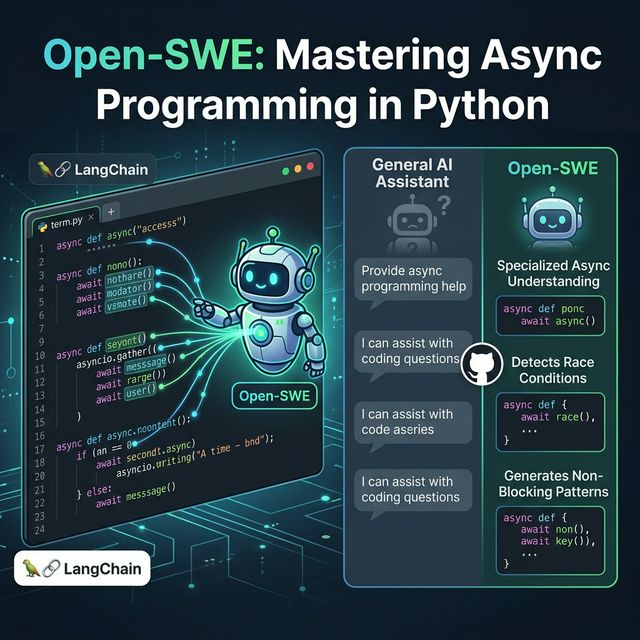
Open-SWE: The Open-Source Coding Agent Built for Async Workflows — When Specialists Beat Generalists
LangChain AI released Open-SWE, the first open-source agent designed specifically for async programming. Analysis of why specialized agents are winning over generalist tools, how Open-SWE approaches non-blocking workflows, and a practical evaluation framework for teams.
When General AI Assistants Fall Short of Async
Asynchronous programming is one of the hardest domains for AI to assist with effectively. The issue isn't syntax — any LLM knows async def and await. The issue is semantic complexity:
- Race conditions only appear in specific execution orders
- Deadlocks occur when a graph of coroutines has cycles
- Context loss when concurrent tasks share mutable state
- Non-blocking patterns require deeper understanding of execution models
General-purpose assistants struggle here because they optimize for breadth, not depth within a specific domain.
Open-SWE from LangChain AI (released March 2026) is the first attempt to build an agent specialized entirely for async workflows — and it's worth paying attention to.
What Is Open-SWE?
According to AIToolly (March 20, 2026), Open-SWE is an open-source SWE (Software Engineering) agent hosted by LangChain AI, designed with a single goal: handling asynchronous programming challenges better than general assistants.
What sources confirm:
- Hosted and developed by LangChain AI
- Open-source — you can inspect the entire decision-making logic
- Specialized focus on the asynchronous programming domain
- Positioned for "agentic" workflows — not just suggesting code, but managing complex async paradigms
What is still developing:
- The project is at an early stage
- Community and benchmark data are limited
- Human review is required for production concurrency changes
Why Specialized Agents Are Winning
The trend Open-SWE represents is not "yet another coding agent" — it's a shift from generalist tools to specialized tools.
Evidence from the field: On SWE-bench Verified, the same model (Opus 4.5) produced results differing by 17 problems when run in different agents. Agent architecture — not the model — is what creates the difference.
The same principle applies to domain specialization:
| Task type | General agent | Specialized agent |
|---|---|---|
| Simple code completion | ✅ Good enough | Over-engineered |
| Async refactoring | ⚠️ Inconsistent | ✅ Optimized |
| Race condition detection | ❌ Unreliable | ✅ Purpose-built |
| Non-blocking orchestration | ⚠️ Hit-or-miss | ✅ Architecturally aware |
Architecture: Why Open Source Matters Here
Open-SWE is open-source, and for async programming, this isn't a marketing point — it's a practical requirement.
When debugging complex concurrency issues, you need to know EXACTLY why the agent suggested this pattern instead of that one. With proprietary tools, you have no way to inspect reasoning. With Open-SWE, you can:
- Trace the exact decision path of the agent
- Modify behavior for specific concurrency patterns in your codebase
- Add domain-specific rules (e.g., constraints of an internal async framework)
- Contribute fixes when you identify wrong patterns
This is why LangChain chose the open-source format — and it's the real differentiator from commercial alternatives.
Practical Evaluation Framework
Before adopting Open-SWE (or any specialized coding agent), run this test battery:
Test 1: Async Refactor
# Give the agent this sync code
def fetch_all_users(user_ids):
    results = []
    for uid in user_ids:
        results.append(fetch_user(uid))  # blocking call
    return results

# Request: "Refactor this to async with proper error handling"
Evaluate: Does the code use asyncio.gather()? Does it handle per-task exceptions? Does it maintain result order?
Test 2: Race Condition Detection
# Code with a potential race condition
shared_state = {}

async def worker(key, value):
    if key not in shared_state:
        shared_state[key] = value  # TOCTOU issue

# Request: "Identify and fix the concurrency issue in this code"
Evaluate: Does the agent identify the TOCTOU issue? Does it suggest the correct solution (asyncio.Lock or async-safe data structure)?
Test 3: Non-blocking Orchestration
Give a pipeline with multiple I/O-bound operations. Ask the agent to optimize for throughput.
Metrics to track:
- Correctness: Does the code run correctly?
- Async clarity: Are patterns idiomatic?
- Performance awareness: Does the agent explain trade-offs?
- Safety: Does the agent warn about potential issues?
Risks and Limitations to Know
Project maturity: Open-SWE is early-stage. This means:
- Fewer production battle tests
- Smaller community → fewer resources when debugging edge cases
- API and behavior may change
Human review is non-negotiable: Any AI-generated concurrency changes require thorough code review. Concurrency bugs are subtle and may not appear in testing — only showing up in production under specific load patterns.
Scope limit: Open-SWE is not a general coding agent. If your team works across many types of tasks, you'll still need a general tool alongside it.
When to Try Open-SWE
Try Open-SWE if:
- Your team works primarily with async stacks (Node, Python asyncio, Rust async)
- You frequently refactor legacy sync code to async
- You need an agent you can inspect and extend (audit trail matters)
- You've hit consistent failures with general agents on async tasks
Not yet if:
- Async is only a small portion of your codebase
- You need a production-ready tool with documented benchmarks
- Your team doesn't have bandwidth to contribute to or debug an open-source tool
Takeaway
Open-SWE is an important signal: AI coding tools are moving from "one tool for everything" toward domain-specific agents.
For teams working with high-performance async systems, an agent that deeply understands asynchronous architecture is better than a general assistant that happens to know some async syntax.
Source: Open-SWE: A New Open-Source Agent for Asynchronous Programming Challenges — AIToolly, March 20, 2026