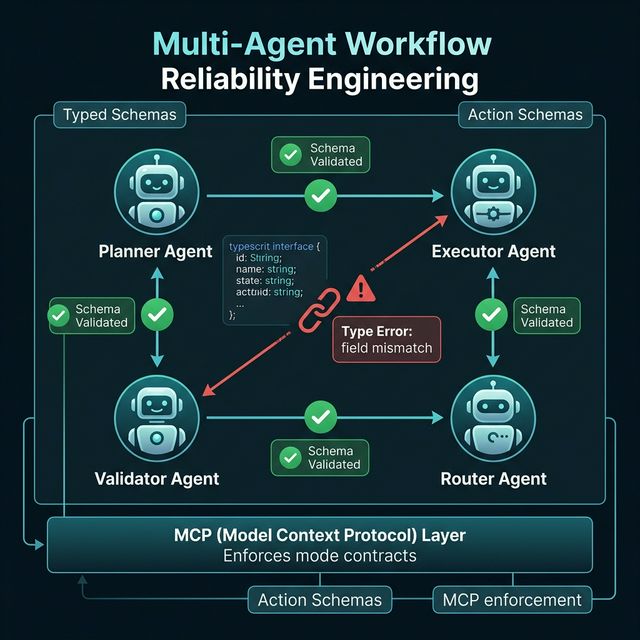
Multi-Agent Workflows Often Fail. Here's How to Engineer Ones That Don't.
Most multi-agent workflow failures come from missing architecture structure, not weak models. GitHub Blog (Feb 2026) identifies 3 engineering patterns: Typed Schemas at every boundary, Action Schemas for explicit intent, and MCP as the enforcement layer. Practical guide for builders.
Why Multi-Agent Systems Break in Ways That Are Hard to Debug
One agent opens an issue. Another one closes it. A downstream check fails because it assumed the issue was still open. You spend two hours figuring out what happened.
This is a typical multi-agent system failure. The cause is not a weak model.
According to GitHub (February 2026), most multi-agent workflow failures stem from missing architectural structure, not from model quality. Once multiple agents touch related tasks, implicit assumptions become time bombs.
Multi-agent systems inherently behave like distributed systems: they have state, ordering, interfaces, validation, and error handling — all hidden, until something breaks.
Failure Pattern #1: Natural Language Between Agents Is Messy
When agents exchange information through unstructured text or inconsistent JSON:
- Field names change between calls
- Data types don't match
- Formatting shifts
- Nothing enforces consistency
Debugging becomes "inspect logs and guess" — instead of "trace failure back to a specific schema violation."
Fix #1: Typed Schemas at Every Boundary
Typed schemas add structure at every handoff point between agents. Agents pass machine-checkable data, invalid messages fail fast, and downstream steps don't have to guess what a payload means.
GitHub's starting point:
type UserProfile = {
  id: number;
  email: string;
  plan: "free" | "pro" | "enterprise";
};
When this schema is enforced:
- Debugging shifts from "inspect logs and guess" → "this payload violated schema X"
- Schema violations are retried, repaired, or escalated — before bad state reaches production
Principle: Treat schema violations like contract failures. Not warnings.
Practical examples:
| Workflow | Benefit of Typed Schema |
|---|---|
| Support ticket triage | Prevents agents from passing incomplete ticket data downstream |
| Lead qualification | Ensures required fields (email, company, plan) always present |
| Research pipeline | Consistent output structure for summarization agent |
Failure Pattern #2: Vague Instructions Create Ambiguous Actions
"Analyze this issue and help the team take action" sounds clear. But 4 different agents could interpret this as 4 different actions — close, assign, escalate, or do nothing. All are reasonable. None are safely automatable.
Model intelligence doesn't eliminate ambiguity — it amplifies it. A smarter model can construct a more persuasive argument for each interpretation, making the problem worse.
Fix #2: Action Schemas — A Constrained Set of Valid Outcomes
Action schemas define exactly which actions are allowed and their structure:
const ActionSchema = z.discriminatedUnion("type", [
  { type: "request-more-info", missing: string[] },
  { type: "assign", assignee: string },
  { type: "close-as-duplicate", duplicateOf: number },
  { type: "no-action" }
]);
With this schema, an agent must return exactly one valid action. Anything else fails validation and is retried or escalated.
Practical result:
- Automation becomes safer — no unexpected edge actions
- Consistency increases — fewer human overrides needed
- Debugging becomes trivial — you know exactly which action was selected
Not every step needs an action schema — but every outcome must resolve to a small, explicit set of actions.
Failure Pattern #3: Loose Tool Interfaces Invite Drift
Without tight tool interface definitions, agents will:
- Invent fields that don't exist
- Omit required inputs
- Drift across interfaces over time
Conventions aren't enough in production systems. You need enforcement.
Fix #3: MCP Is the Enforcement Layer
Model Context Protocol (MCP) is the layer that turns typed schemas and action schemas from conventions into contracts.
MCP defines explicit input/output schemas for every tool and resource — validation happens before execution:
{
  "name": "create_issue",
  "input_schema": { ... },
  "output_schema": { ... }
}
With MCP:
- Agents cannot invent nonexistent fields
- Required inputs cannot be omitted
- Interface drift is prevented at the source
- Bad state never reaches production systems
MCP isn't just hype — it's the infrastructure layer that solves the enforcement problem typed schemas and action schemas can't solve alone.
Practical Framework: Reliable Multi-Agent Design
Combine the 3 fixes into a design checklist:
✅ Define schemas first — before writing any agent code
✅ Reduce actions to explicit allowed outcomes
✅ Validate every handoff — no messy payloads allowed
✅ Separate planning from execution — agents have clear roles
✅ Log decisions and payloads — observability is not optional
✅ Escalate on contract violations — never silently fail
3 Golden Rules:
- Typed schemas = table stakes. No schemas = no reliability.
- Action schemas = every outcome must be explicit. "Something reasonable" isn't good enough.
- MCP = enforcement, not convention. Contracts, not guidelines.
Where This Matters Most
| Workflow | Common Failure Point | Key Fix |
|---|---|---|
| Issue triage pipeline | Agents conflict on same issue | Action Schema |
| DevOps automation | Deployment state inconsistency | Typed Schema + MCP |
| Customer support routing | Double-handling same ticket | Action Schema |
| Content production pipeline | Format drift between agents | Typed Schema |
| Security review workflow | Missing required fields | MCP enforcement |
| Internal knowledge assistant | Context loss between agents | Typed Schema |
Common Mistakes to Avoid
- Allowing free-form outputs everywhere → nothing can validate downstream
- Overusing natural-language-only instructions → ambiguity compounds at each step
- Skipping validation → bad state propagates to production silently
- Mixing too many responsibilities into one agent → harder to debug, harder to constrain
- Giving agents broad actions without constraints → unexpected side effects at edge cases
Takeaway
Treat agents like software components, not chatbots.
Multi-agent reliability doesn't come from smarter models — it comes from structured architecture. Typed schemas at every boundary. Action schemas for every outcome. MCP as the enforcement layer.
Teams that learn this early will ship better agent systems faster. Teams that skip it will keep debugging failures that look like model errors but are actually architecture errors.
Source: Multi-agent workflows often fail. Here's how to engineer ones that don't. — GitHub Blog