Google Cloud Next 2026: Architecting the Gemini Enterprise Agent Platform
Google's Cloud Next 2026 definitively signals the death of isolated chat copilots. Production agents now demand stateful runtimes, strict governance, persistent memory banks, and heavy observability.
Google aggressively leveraged Cloud Next 2026 to unveil the Gemini Enterprise Agent Platform. This is not simply a rebranding exercise of Vertex AI. This announcement defines a structural standardization for how massive corporations will architect, orchestrate, and govern production AI systems moving forward.
For independent builders, startups, and technical operators, this launch is an absolute blueprint. The market is aggressively shifting from isolated "consumer-facing copilots" to rigid, stateful, heavily governed production agents.
Dissecting the Platform Architecture
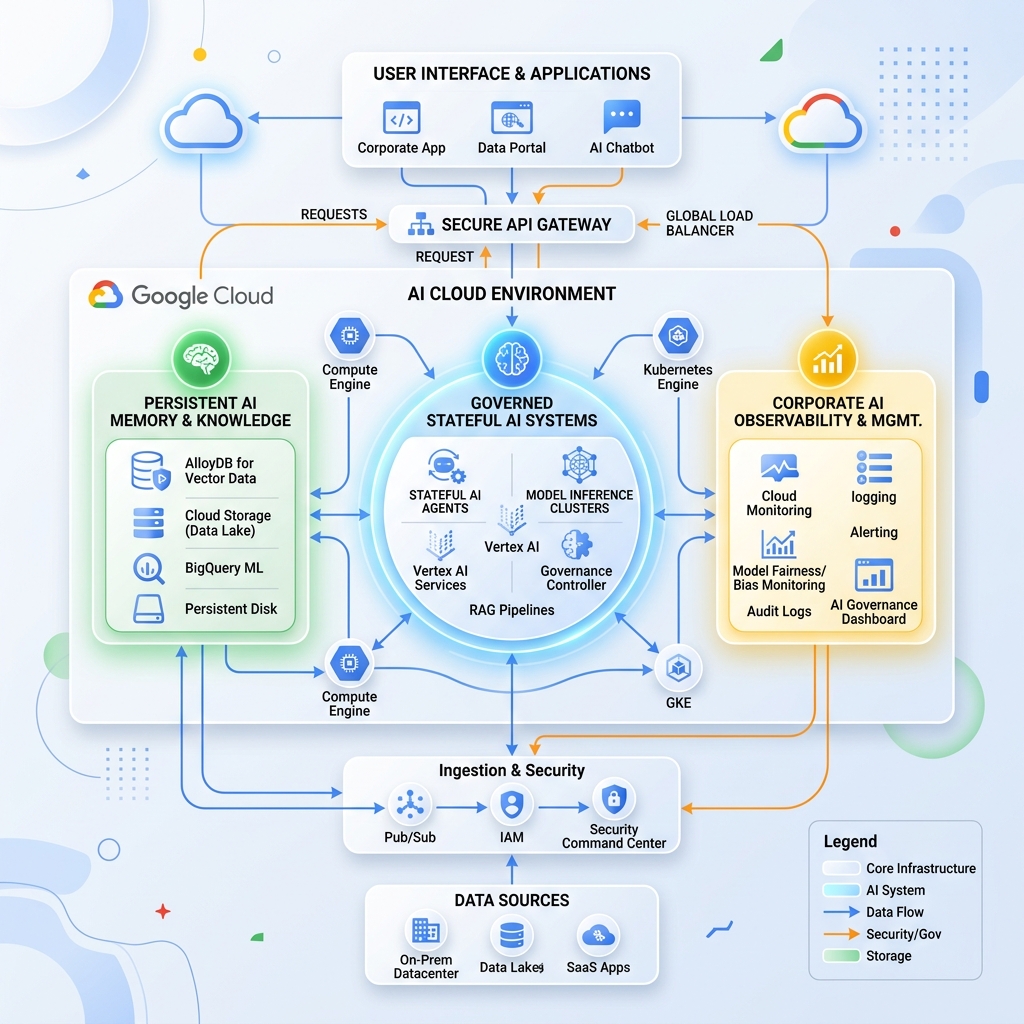
Google dismantled their AI deployment process into these specific core primitives:
- Agent Studio: A low-code visual scaffolding layer for non-technical domain experts.
- Agent Development Kit (ADK): A raw code-first SDK engineered for hardcore technical integration.
- Agent Runtime: A specialized execution engine tailored for long-running, asynchronous, heavily stateful operations.
- Memory Bank: A dedicated persistent context engine enabling agents to remember logic across days of task execution.
- Agent Identity, Registry & Gateway: A strict governance matrix identifying permissions and network access rules for individual autonomous agents.
- Simulation, Evaluation & Observability: Hardcore quality control tracking deep reasoning traces, logging latency, and testing agents in sandbox environments prior to live deployment.
3 Massive Strategic Signals for Builders
Even if you aren't an enterprise-level architect deploying Google Cloud, you must respect the trends established here:
- Stateful Agents are Now Mandatory: The era of basic ephemeral prompts is dead. Complex workflows require tasks that operate over consecutive days, reading and writing to isolated Memory Banks.
- Governance is Productized: An autonomous agent cannot operate globally. It requires a specific IAM (Identity and Access Management) profile, passing through an API Gateway just like a human engineer.
- Observability is the Baseline: Blindly deploying an agent is architectural malpractice. You must implement execution traces, simulation sandboxes, and rigid evaluation loops.
Implementing This Pattern Locally
You do not need Google's multi-million dollar infrastructure to deploy these principles within your startup stack. Begin by restructuring your perspective:
- Treat Agents as Microservices: Stop writing heavy prompt loops. Treat the agent as an asynchronous background worker in a queue that handles specific data inputs.
- Selective Memory Parsing: Do not dump massive unstructured context. Segment persistent memory files so agents retrieve exact situational history.
- Enforce Evaluation Tasks: Design scripts to automatically sanity-check the agent's output logic before it proceeds to touch external APIs or email databases.
Recommended Architectural Stack Blueprint:
- Front-End Request Layer
- Planner / Orchestrator Engine
- Tool Execution Layer (MCP Connections)
- Memory Layer (Vector & Relational States)
- Runtime / Queue (Asynchronous Retries)
- Observability / Tracing Engine
- Governance / Permissions Control
Final Thought: The enterprise AI industry has completely pivoted away from "Who has the highest benchmarked foundational model" to "Who possesses the most rigid, fault-tolerant Production Agent System." Align your architecture with that reality immediately to future-proof your product.