CoPaw: Personal Agent Workstation With Persistent Memory — From Amnesiac Chatbot to Real Agent
Alibaba's AgentScope team open-sourced CoPaw — a 'Personal Agent Workstation' solving two core problems of AI tools: memory loss between sessions and inability to deploy consistently across channels. Architecture analysis of AgentScope + ReMe Memory + Skills System with a practical evaluation checklist.
The Problem CoPaw Solves
Today's popular chatbots and AI assistants have two fundamental problems that don't get addressed directly:
1. Amnesia: Every conversation starts from zero. Nothing remembers who you are, what style you prefer, or which project you're working on. You re-brief every single time.
2. Fragmentation: The tool you use on Slack is different from the one on Discord, which is different from the web interface — no consistency, no shared context.
CoPaw from Alibaba's AgentScope team (released early 2026) is an open-source attempt to solve both problems simultaneously with the concept of a "Personal Agent Workstation" — not a chatbot, but a workstation with memory, skills, and multi-channel access.
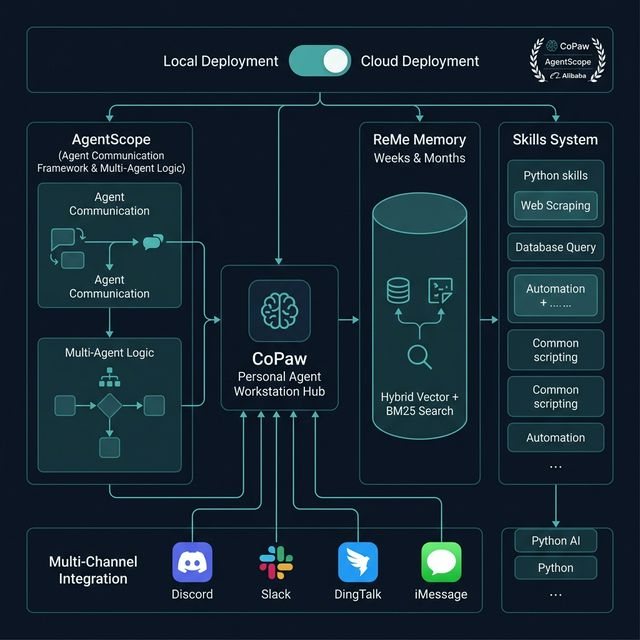
Three-Layer Architecture
CoPaw is built on three main components working together:
Layer 1: AgentScope — Agent Communication & Logic
AgentScope is Alibaba's open-source Python framework for multi-agent applications. In CoPaw, it handles:
- Agent communication protocol
- Multi-agent orchestration logic
- Transparency layer — you can inspect prompts, API calls, memory operations, and workflows
Transparency here is not a secondary feature — it's a design principle. For production agent systems, the ability to trace every decision is critical.
Layer 2: ReMe Memory — Long-Term Experience Engine
ReMe (Remember Me, Refine Me) is CoPaw's biggest differentiator from typical AI tools.
What ReMe does:
- Persistent memory across weeks and months (not just within-session)
- File-based storage — memory is editable, exportable, and portable
- Hybrid retrieval: combines semantic vector search + BM25 keyword search
- Context compaction: summarizes long conversations to stay within LLM context limits
What ReMe remembers:
- User preferences and working style
- Past task patterns
- Project context
- Brand guidelines, tone preferences
Practical example: Instead of "remember that I write technical docs in a concise, bullet-heavy style," you say it once — ReMe stores it and applies it automatically from that point forward.
Layer 3: Skills System — Python-Based Extensibility
Skills are Python extensions that let CoPaw perform custom capabilities:
- Web scraping
- Database queries
- Workflow automation
- API integrations
- Scheduled tasks (built-in cron)
Why the skills design matters: Skills decouple capabilities from the core engine. You don't have to wait for a vendor to release a new feature — you write the skill you need. And skills are pure Python, not a proprietary DSL.
Multi-Channel Access
CoPaw deploys a single consistent agent across multiple platforms:
- Discord
- Slack
- DingTalk
- Feishu
- iMessage
The key point: These are not separate integrations for each channel. A single CoPaw agent with the same memory and settings operates across all of them. You ask something on Slack this morning and continue on Discord this evening — the context is consistent.
Local vs Cloud Deployment
CoPaw offers two options with clear trade-offs:
| Local Deployment | Cloud Deployment | |
|---|---|---|
| Privacy | Maximum — data never leaves machine | Standard cloud privacy |
| Availability | Only when machine is on | 24/7 |
| Cost | LLM API costs only | Add hosting costs |
| Setup | More complex | Easier for non-technical users |
| Ideal for | Privacy-sensitive data | Production workstations |
For sensitive data (internal company knowledge, personal preferences), local deployment is the stronger choice.
Starter Architecture: Getting Started Practically
No need to deploy the full system immediately. Recommended path:
Week 1: Single agent + 1 skill
├─ Deploy CoPaw locally
├─ Enable ReMe basic memory
└─ Write 1 simple skill (e.g., query internal FAQ)

Weeks 2-3: Expand
├─ Add 2-3 most-needed skills
├─ Enable multi-channel access (start with 1-2 channels)
└─ Tune memory settings

Month 2: Scale
├─ Multi-agent if needed
├─ Advanced scheduling
└─ Share skills with team
Evaluation Checklist Before Adopting
- Memory persistence: Verify memory actually persists across sessions and restarts
- Skill safety: Code-review Python skills before running (no arbitrary execution without review)
- Deployment footprint: Assess resource usage for local deployment
- Observability: Can you trace why the agent made a specific decision?
- Failure modes: Behavior when LLM is unavailable? When memory is corrupted?
- Privacy audit: Which data is sent externally? Which stays local?
- License: Apache 2.0 — compatible with commercial use
Security and Privacy Implications
Local memory is a double-edged sword:
✅ Upside: Data never leaves the machine. No vendor data sharing. No third-party memory access.
⚠️ Downside: Memory files need protection. If the machine is compromised, memory is compromised. A solid backup strategy is as important as the data strategy itself.
ReMe uses file-based storage — meaning you can edit, backup, and migrate memory. But it also means memory has no built-in encryption. For sensitive data, you'll need to add an encryption layer.
Where CoPaw Fits in a Modern Stack
| Tool type | Description | When appropriate |
|---|---|---|
| SaaS Copilots (Copilot, ChatGPT) | Cloud-hosted, no memory, generic | Quick one-off tasks |
| Single-agent tools | Stateless, task-specific | Narrow automation |
| CoPaw | Persistent, multi-skill, multi-channel | Personal workflow automation |
| Enterprise platforms | Managed, compliant | Large team deployments |
CoPaw sits at the "advanced personal workstation" level — more powerful than chatbots, simpler than enterprise platforms, and better than single-agent tools when continuity matters.
Takeaway
CoPaw addresses the right problem: today's AI tools are too stateless to become genuine workflow partners.
With ReMe Memory, CoPaw doesn't just "remember" — it builds actual long-term understanding of the user. With the Skills System, it can extend to meet real needs. With multi-channel access, it's available wherever the user works.
The trade-off: more complex setup than SaaS tools and requires maintenance. But for teams that want full control over their AI assistant, this is a compelling option.
Sources: CoPaw — GitHub | AgentScope | MarkTechPost