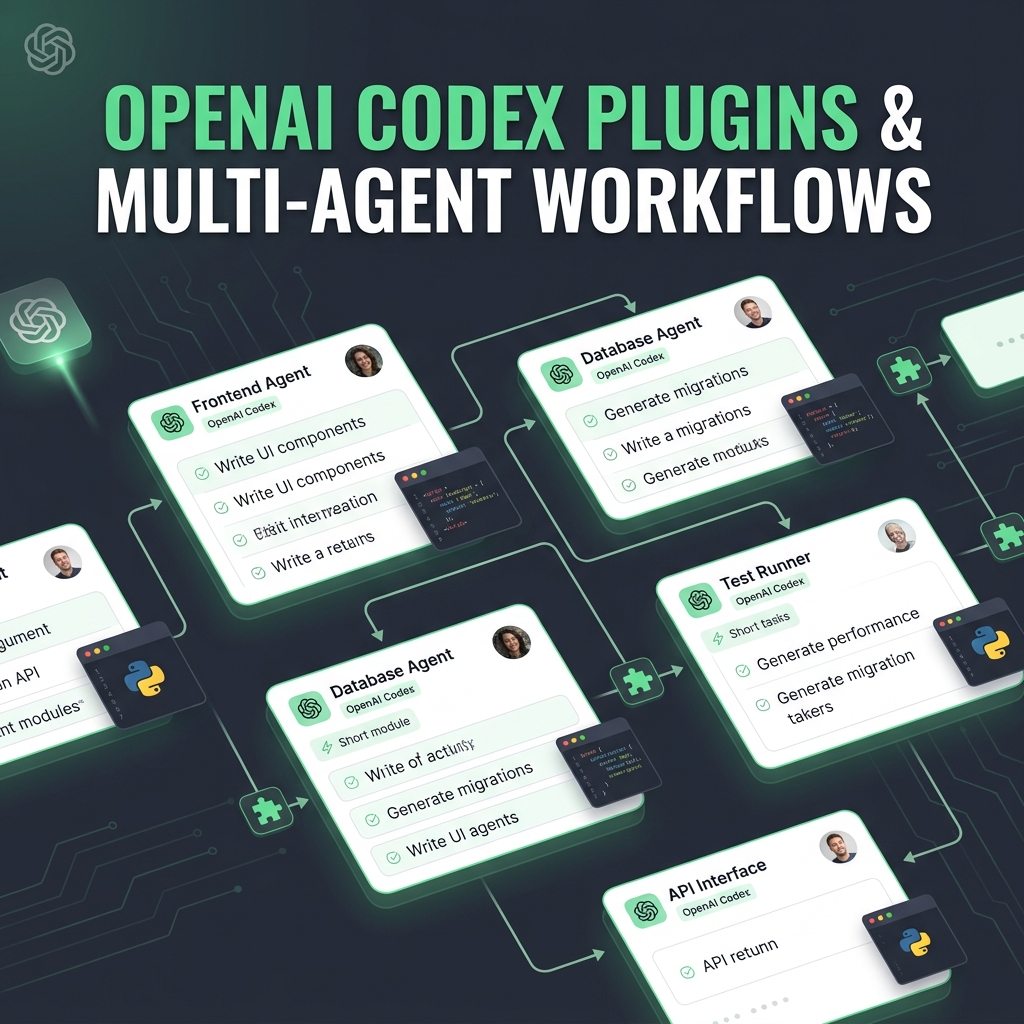
OpenAI Codex Plugins and Multi-Agent Workflows — When Coding Agents Become Operations Infrastructure
Codex is no longer a chat assistant for developers. With first-class plugins, path-based sub-agents, and structured messaging — Codex is evolving into a workflow layer for multi-agent software delivery. Practical analysis for engineering teams.
Codex Is No Longer a Chat Assistant
If you still think OpenAI Codex is just "ChatGPT that writes code" — you're missing a critical shift.
In March 2026, OpenAI shipped a cluster of updates that transform Codex from a coding assistant into a workflow layer for multi-agent software delivery:
- Plugins became a first-class workflow
- Sub-agents got clear path-based addressing and structured inter-agent messaging
- Cloud handoff, GitHub review workflows, and automations were significantly enhanced
This article analyzes what actually changed and how engineering teams can operationalize Codex as infrastructure — not just a chat tool.
What Changed in Codex — March 2026
Plugins — First-Class Workflow
Plugins are no longer add-ons. Codex now supports:
- Syncing product-scoped plugins at startup
- Browsing, installing, and removing plugins from a directory
- Plugins bundling skills, app integrations, and MCP/server configuration
In plain English: Instead of copying prompts into a coding tool each time, you package workflows into reusable plugins.
Sub-Agents — Path-Based Addressing
Sub-agents now have clear path-based addresses (e.g., agents/frontend, agents/database), supporting:
- Structured inter-agent messaging
- Agent listing for multi-agent v2 workflows
- Parallel task distribution across specialized agents
Cloud Handoff & GitHub Review
- Cloud handoff: Delegate heavy tasks to cloud environments, continue working locally
- GitHub review mode: Codex reviews PRs, suggests fixes, drafts comments
- Automations: Triage, CI/CD, and recurring maintenance tasks
Why Plugins Matter More Than They Sound
| Old Workflow | New Workflow with Plugins |
|---|---|
| Copy prompt into tool each time | Install plugin, rerun anytime |
| Each dev has different setup | Plugin syncs conventions across team |
| Setup drift between projects | Plugin packages reusable across repos |
| Manual MCP config | Plugin bundles MCP + app integrations |
Who benefits most:
- Agencies — productize delivery workflows as plugins for clients
- Internal platform teams — standardize AI development workflows
- Devtool-heavy startups — reduce onboarding time for new developers
The Real Story: Multi-Agent Orchestration
Plugins matter, but multi-agent orchestration is the paradigm shift.
Example: 4 Parallel Agents
| Agent | Role | Input | Output |
|---|---|---|---|
| 🔍 Research Agent | Survey codebase, find patterns | Repo context | Architecture notes |
| ✍️ Write Agent | Write/refactor code | Architecture notes + task spec | Code changes |
| 🧪 Test Agent | Write tests, run reviews | Code changes | Test results + review |
| 📝 Docs Agent | Update docs, release notes | Code changes + test results | Documentation |
Why This Beats One Mega-Agent
- Reduced context overload — each agent only holds necessary context
- Parallel execution — Research Agent finishes → Write + Test Agents run simultaneously
- Easier debugging — you know exactly which agent failed, at which step
- Reusable — Test Agent works across any project
A Practical Operating Model for Teams
5-Layer Architecture
┌─────────────────────────────────────────┐
│  LOCAL ENV        Interactive work       │
├─────────────────────────────────────────┤
│  CLOUD HANDOFF    Long-running tasks     │
├─────────────────────────────────────────┤
│  GITHUB REVIEW    PR feedback & fixes    │
├─────────────────────────────────────────┤
│  PLUGINS          Standard workflows     │
├─────────────────────────────────────────┤
│  AUTOMATIONS      Triage, CI/CD, maint   │
└─────────────────────────────────────────┘
Sample Weekly Workflow
| Day | Developer | Codex |
|---|---|---|
| Monday | Code locally, assign refactor task | Delegate refactor to cloud |
| Tuesday | Review cloud output, merge | Automation checks PR quality |
| Wednesday | Design new feature | Research Agent surveys affected files |
| Thursday | Implement feature | Write Agent + Test Agent run in parallel |
| Friday | Final review, deploy | Docs Agent updates changelog, release notes |
Codex Vs. the Coding Agent Market
| Type | Examples | Strength | Limitation |
|---|---|---|---|
| Chat copilots | GitHub Copilot inline | Fast, low friction | Can't orchestrate |
| Autonomous agents | Devin, SWE-Agent | End-to-end tasks | Hard to govern |
| Workflow systems | Codex (new) | Plugin + multi-agent + review | Ecosystem still new |
Key insight: Workflow packaging + multi-agent coordination is a more durable moat than raw model quality alone. Teams should evaluate orchestration, review quality, and deployability — not just benchmark scores.
Limitations and Adoption Risks
- Plugin governance — Who writes plugins? Who reviews them? Permission design matters
- Parallel agent complexity — Multiple agents need clear boundaries
- Ownership conventions — Teams need rules: who owns which agent's output?
- Security & auditability — More automation means stricter logging and sandboxing
- Plugin ecosystem — Still early, limited quality community plugins
Who Should Pay Attention Now
| Group | Why |
|---|---|
| Teams using coding assistants feeling scaling friction | Plugins reduce setup drift, multi-agent reduces context overload |
| Small startups shipping fast | 1 dev + multi-agent = output of a 3-4 person team |
| Platform/DevEx teams | Standardize AI workflows org-wide |
| Consultants/Agencies | Productize delivery as reusable agent workflows |
Takeaway
Codex is shifting from assistant UX to agent operations infrastructure. Start experimenting with:
- One reusable plugin — package your team's conventions/workflow
- One parallel workflow — Research Agent + Write Agent for a specific task
The biggest win isn't "write code faster" — it's turning repeatable engineering work into systems.
Sources: OpenAI Codex Changelog · OpenAI Codex Product