Best AI Developer Tools March 2026: A Framework for Choosing the Right Tool for Your Workflow
LogRocket just published its March 2026 AI dev tool power rankings covering 12 tools and 18 models. Instead of another pointless listicle, here's a practical framework for choosing the right AI coding tool for how you actually work.
TL;DR
According to the LogRocket March 2026 AI power rankings: Windsurf #1 (agentic workflow), Antigravity #2 (free disruptor), Cursor #3 (premium powerhouse), Claude Code #4 (quality-first), Codex #5 (enterprise cloud). But rankings aren't everything — the best tool is the one that fits your workflow, not the one at the top of the leaderboard.
Most "AI coding tools comparison" articles make the same mistake: they collapse all tools into one list and pick a "winner" based on benchmarks or GitHub stars.
That's useless because AI developer tools in March 2026 don't do the same job.
This article takes a different approach. Instead of pure rankings, here's a framework to help you choose based on how you actually work.
The March 2026 Landscape: A Market Fragmenting by Design
LogRocket just published their March 2026 update comparing 12 AI tools and 18 AI models. Here's the quick snapshot:
AI Model Rankings (Top 5)
| # | Model | Key highlights |
|---|---|---|
| 1 | Claude 4.6 Opus | 1M context window (beta), Agent Teams, effort controls |
| 2 | Gemini 3.1 Pro | Best price-to-performance: $2/$12, ARC-AGI-2 score 77.1% |
| 3 | Claude Sonnet 4.6 | Default free on claude.ai, 1M context, near-Opus performance |
| 4 | Claude 4.5 Opus | Highest verified SWE-bench (76.8%), but most expensive at $5/$25 |
| 5 | GLM-5 | Open-source leader |
AI Tool Rankings (Top 5)
| # | Tool | Key highlights |
|---|---|---|
| 1 | Windsurf | Agentic workflow champion, Arena Mode, Plan Mode, Free-$60 |
| 2 | Antigravity | Completely free in preview, multi-agent orchestration |
| 3 | Cursor IDE | Premium powerhouse, 8 parallel agents, Free-$200 |
| 4 | Claude Code | Quality-first, 1M context, $20-$200 |
| 5 | Codex | Enterprise cloud agent, async parallel, native GitHub integration |
The 5 Real Categories of AI Developer Tools
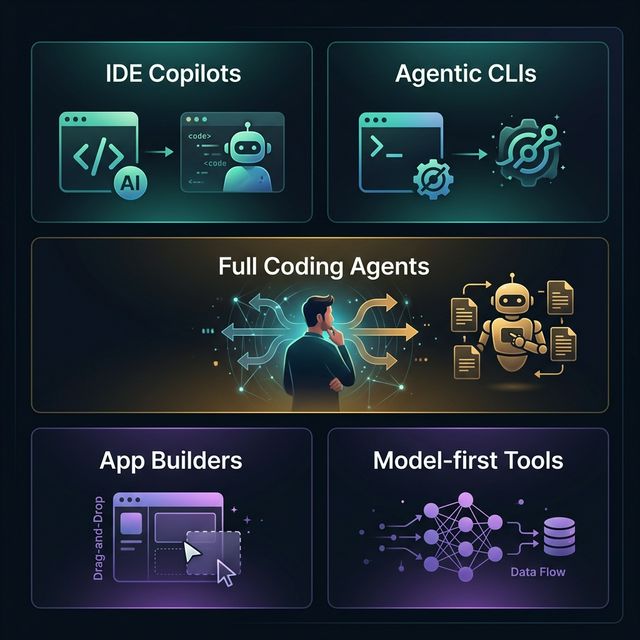
This is the most important section. Today's market splits into 5 distinct categories, each serving a different use case:
1. IDE Copilots — Inline Assistance, Lowest Friction
Characteristics: Deep editor integration, intelligent autocomplete, in-IDE chat, minimal context switching.
Best when: You want AI assistance without changing your existing workflow. Small-to-medium codebases. Need quick suggestions without agent reasoning.
Examples: GitHub Copilot, Gemini Code Assist (VS Code/JetBrains plugins)
2. Agentic CLIs — Repo-wide Reasoning, Terminal-centric
Characteristics: Runs in the terminal, understands the full repo, can plan and execute complex tasks, often has plan mode.
Best when: You live in the terminal. Need an agent that understands the whole codebase, not just the open file. Want a planning-first workflow.
Examples: Gemini CLI, Claude Code (CLI mode), Codex CLI, Antigravity
3. Full Coding Agents — Planning + Execution Loops
Characteristics: IDE-integrated with full agentic capabilities. Broad codebase understanding. Complete plan-execute-review loop. Native multi-file edits.
Best when: You need autonomous capability for larger tasks. Want a complete workflow from planning to rollback in one tool.
Examples: Windsurf (Cascade), Cursor (Composer), Claude Code (full), Antigravity
4. App Builders / UI Generators — Rapid Prototyping, Frontend-heavy
Characteristics: Generate entire apps from natural language. Live preview. Design-to-code. Best for greenfield projects.
Best when: Need to ship an MVP fast. Frontend-heavy work. Non-technical team members need to participate. Not integrating into complex existing codebases.
Examples: Bolt.new, Vercel v0, Lovable AI
5. Model-first Tools — Raw Intelligence, Custom Workflow
Characteristics: Direct access to powerful models via API or chat. Flexible but requires more setup. Best when you want to build custom workflows.
Best when: Use case doesn't fit pre-built tools. Need model-specific capabilities. Want total control over prompting and workflow.
Examples: Claude.ai, ChatGPT, Direct API access
A Decision Framework for Choosing Your Tool
Instead of asking "which tool is best?", ask:
Question 1: What's your editing style?
- I want AI to suggest while I code → IDE Copilot
- I want to describe a task and let AI handle it → Agentic CLI or Full Coding Agent
- I want to build something new fast → App Builder
Question 2: How large is your codebase?
- < 5,000 files, small project → Any tool works well
- 5,000–50,000 files, medium → Need strong context handling (Windsurf, Cursor, Claude Code)
- > 50,000 files, large codebase → Enterprise features and privacy controls (Codex, Copilot Enterprise)
Question 3: How much autonomy do you need?
- Low: I want to control every step → IDE Copilot or Gemini CLI Plan Mode
- Medium: approve the plan, agent executes → Windsurf Cascade, Cursor Composer
- High: async parallel tasks → Codex (cloud-based, headless)
Question 4: What's your budget?
- Free or near-free → Antigravity (preview), Gemini CLI, Gemini Code Assist (free tier)
- $20-60/month → Windsurf Pro, Cursor Pro
- $100-200/month → Cursor Max, Claude Code Max
- Enterprise → GitHub Copilot Enterprise, Codex Enterprise
Detailed Breakdown of the Top 5 Tools
Windsurf — Agentic Workflow Champion (#1)
Best for: Developers who want a complete agentic experience at accessible pricing.
Strongest feature: Arena Mode (side-by-side model comparison with voting), parallel multi-agent sessions with Git worktrees, Plan Mode before code generation.
Biggest limitation: Less customization than Cursor for enterprise setups.
Ideal user: Mid-to-senior developer who wants a complete agentic workflow without overpaying.
Antigravity — The Free Disruptor (#2)
Best for: Developers who want multi-agent orchestration completely free during preview.
Strongest feature: Multi-agent orchestration + integrated Chrome browser automation. Supports Gemini 3.1 Pro, Claude Sonnet/Opus 4.5, and GPT-OSS models.
Biggest limitation: Still in preview — pricing model at GA is unknown.
Ideal user: Indie hackers, experimenters, developers who want to test agentic workflows without cost risk.
Cursor IDE — The Premium Powerhouse (#3)
Best for: Teams prioritizing maximum productivity with budget available.
Strongest feature: Composer model (4x faster), up to 8 parallel agents, visual editor that bridges design and code, shared transcripts for enterprise.
Biggest limitation: $200 max tier is expensive. Windsurf challenges its value proposition with lower pricing and comparable features.
Ideal user: Engineering teams with budget who need maximum throughput and enterprise controls.
Claude Code — Quality-first Professional (#4)
Best for: Developers who prioritize code quality and reasoning depth over speed.
Strongest feature: Opus 4.5/4.6 are currently the best coding models. 1M context in beta, automatic memory recording, context compaction.
Biggest limitation: $20-$200 pricing with no free tier. Less accessible than alternatives.
Ideal user: Senior developers and teams working on complex codebases where code quality is paramount.
Codex — The Enterprise Cloud Agent (#5)
Best for: Teams already in the OpenAI/GitHub ecosystem needing async parallel cloud execution.
Strongest feature: Runs in isolated cloud sandboxes — doesn't block local development. Auto PR creation, GPT-5/5.2 support, audit trails.
Biggest limitation: Cloud-only execution model doesn't suit teams needing local or offline support.
Ideal user: Enterprise teams with heavy GitHub workflows needing compliance and full audit trails.
Persona-Based Recommendations
| Persona | Recommendation | Why |
|---|---|---|
| Solo indie hacker | Antigravity (free) + Windsurf | Ship fast, zero cost |
| Backend engineer, mature codebase | Gemini CLI + Claude Code | Safe repo-wide changes, quality |
| Frontend/UI builder | Windsurf + Bolt.new | IDE workflow + rapid prototyping |
| Team lead | Cursor or Windsurf | Reviewability, team features, pricing clarity |
| Enterprise | Copilot Enterprise or Codex | Compliance, audit, enterprise controls |
The Most Important Trend: Workflow Products Will Win
If I had to pick one insight from March 2026, it's this:
The winners aren't the tools that generate the best code. The winners are the tools that remove the most friction across the entire workflow.
Windsurf is #1 not because it has the best model — but because Arena Mode + Plan Mode + parallel agents + pricing creates the most complete workflow experience.
Antigravity is #2 not because it has the strongest model — but because multi-agent orchestration + browser automation + completely free is a combination disrupting the entire market.
When choosing a tool, ask: "Where does this tool reduce friction in my workflow?" — not "What rank does this tool have in benchmarks?"
FAQ
Do these rankings change frequently? Very frequently. LogRocket publishes monthly updates. The AI dev tools market moves fast — March rankings may look significantly different by April.
Is Antigravity really completely free? According to LogRocket: "Antigravity disrupts the market as completely free during preview with no paid tier yet." Pricing at GA has not been announced.
Should I use multiple tools? Many developers use combinations: Gemini CLI for planning, Claude Code for complex reasoning, Bolt.new for rapid UI prototyping. There's no rule against using multiple tools.
Is Codex the same as Claude Code? No. Codex is OpenAI's cloud-based coding agent, running in isolated sandboxes with deep GitHub integration. Claude Code is Anthropic's terminal-based agent, running locally.
What's the difference between Gemini CLI and Gemini Code Assist? Gemini CLI is a command-line agent running in the terminal, best forRepo-wide tasks. Gemini Code Assist is an IDE plugin (VS Code/JetBrains), best for inline assistance while coding.