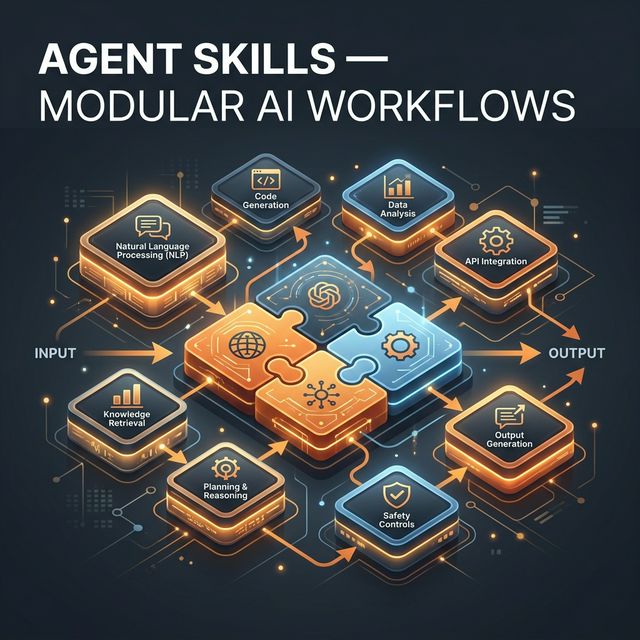
Agent Skills Explained: Why Reusable Skills May Become the Standard Layer for Agent Workflows
Single prompts don't scale for repeatable AI agent workflows. Anthropic introduced Agent Skills — modules that package instructions, scripts, and resources for agents to load on demand. This article explains what skills are, compares them to Prompts/Tools/MCP, covers real use cases, and outlines how to build an internal skill library.
The Problem: Single Prompts Don't Scale
Most AI agent workflows today operate by cramming all instructions into one long prompt and hoping the agent understands and executes correctly.
This approach has clear problems:
- Long prompts → expensive tokens, reduced output quality
- Not reusable → instructions must be rewritten for each task
- No version control → institutional knowledge lives in someone's head
- Not shareable → other team members don't know what prompts you use
Agent Skills from Anthropic are the answer to this problem.
What Are Agent Skills?
According to Anthropic's official blog:
A Skill is a folder containing:
- Instructions (SKILL.md) — detailed guidance for the agent
- Scripts — executable support code (Python, Bash...)
- Resources — templates, examples, validation rules
- Optional logic — automated logic that runs when the skill is loaded
The agent only loads a skill when it's relevant — not everything gets crammed into context. This solves the prompt bloating problem.
In simple terms:
Skill = packaged domain expertise as a reusable, versioned, auditable module.
Why Skills Matter for Real-World Agents
1. Reduce Prompt Bloat
Instead of a 5000-token system prompt, the agent loads only the skill needed for the current task.
2. Improve Consistency
A skill packages exactly how an agent should handle a task type. Every team member using the same skill → consistent output.
3. Capture Institutional Knowledge
Team best practices are no longer trapped in a senior engineer's head. They're codified into version-controlled skill files.
4. Share and Version
Skills are stored as files → git versioning → PR review → shared across teams.
5. Executable Logic
Not just text instructions — skills can contain runnable scripts (lint, test, validate) → the agent actually does work, not just describes how to do it.
Comparison: Prompt vs Tool vs MCP vs Skill
| Abstraction | Role | Example |
|---|---|---|
| Prompt | Frame the task, set context | "Write an API endpoint following REST conventions" |
| Tool | Execute a specific action | grep_search, run_command, edit_file |
| MCP | Connect to external systems | MCP server for CRM, Notion, GitHub |
| Skill | Package reusable know-how | Folder with coding standards + lint scripts + templates |
All 4 layers are necessary in mature agent systems:
- Prompts initiate tasks
- Skills provide domain expertise
- Tools execute actions
- MCP connects external data
Skills complement MCP, they don't replace it. MCP = connect data. Skill = package how to process data.
Best Use Cases for Skills
Coding Teams
- Coding conventions: Skill containing naming, structure, error handling rules → Claude Code auto-applies
- Test patterns: Skill with unit test templates, AAA pattern, coverage requirements
- PR review checklist: Skill with review criteria + validation scripts
Content & Marketing Teams
- Brand voice: Skill packaging tone, terminology, do/don't → consistent content output
- SEO writing: Skill with keyword research templates, meta tag patterns, heading structure rules
- Social media: Skill formatting posts per platform-specific rules
Operations & Internal Tools
- SOP execution: Standard Operating Procedures as executable skills
- Onboarding: Skill guiding the agent to generate onboarding docs from company wiki
- Reporting: Skill templates for weekly/monthly reports from data sources
How to Build an Internal Skill Library
Step 1: Identify Repeatable Workflows
Ask your team: "What task do we do 3+ times per week that requires re-explaining every time?"
Step 2: Package Into a Skill
skills/
├── code-review/
│   ├── SKILL.md          # Detailed instructions
│   ├── scripts/
│   │   └── lint_check.py # Auto-lint before review
│   └── examples/
│       └── good_pr.md    # Example of a good PR
├── seo-writing/
│   ├── SKILL.md
│   └── resources/
│       └── keyword_template.md
Step 3: Keep Skills Narrow
❌ Too broad: "Everything about code quality"
✅ Right scope: "Python unit test patterns for FastAPI services"
Step 4: Version Like Code
- Commit skill files to git
- PR review when skills change
- Tag versions when skills stabilize
Step 5: Audit for Trust & Safety
Skills can execute scripts → security review is mandatory:
- What side effects do scripts have?
- Do they access the filesystem unnecessarily?
- Do they call unwanted external APIs?
Risks to Watch
| Risk | Mitigation |
|---|---|
| Skill scope too broad → unreliable | Keep each skill to one clear responsibility |
| Third-party skills may contain malicious code | Review source before importing |
| Skill sprawl (too many unmanaged skills) | Governance: ownership + audit cycle |
| Skills over-fitted to one specific team | Design for reusability across similar teams |
| No observability | Log when skills are loaded and their outcomes |
Why This Matters Beyond Anthropic
Cross-platform portability is the bigger story. Teams want reusable agent capabilities that survive model and vendor shifts. If you build skills for Claude Code today, the concept transfers to any other agent framework:
- Skill = folder of instructions + scripts + resources
- Not dependent on a vendor-specific API
- This pattern is becoming an industry standard for modular agent design
Conclusion
The next wave of agent quality improvements may come not from bigger models or longer prompts — but from better workflow packaging. Agent Skills are the strongest candidate for that packaging layer.
Try it now: Audit one repetitive workflow in your stack this week. Redesign it as a reusable skill with instructions, examples, and validation steps.