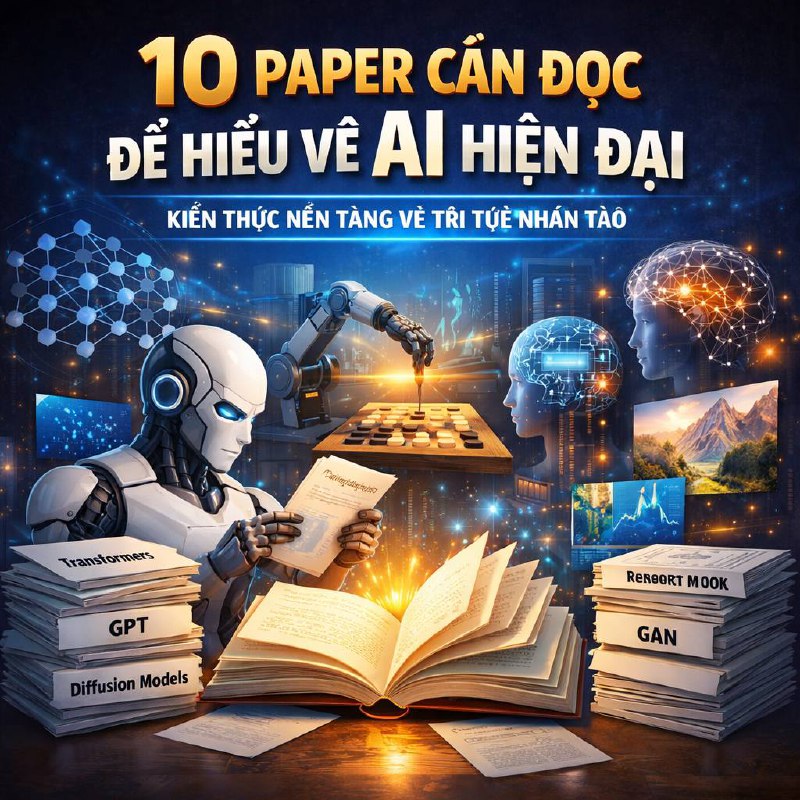
The 10 Most Important AI Papers You Need to Understand Modern AI
From Transformer to Diffusion Models, from RLHF to Scaling Laws — the 10 foundational research papers that shaped the entire modern AI revolution, explained simply.
Over the past few years, AI has advanced at an extraordinary pace. Models like ChatGPT, Midjourney, Claude, Gemini, and Sora are changing how we work and create.
But behind these powerful AI products are foundational research papers that have shaped the entire field of modern artificial intelligence. If you want to understand how AI actually works, here are the 10 most important papers you should know.
From Transformer to Scaling Laws — the foundations of the AI revolution
1. Attention Is All You Need (2017)
This is the single most important paper in modern AI.
This paper introduced the Transformer architecture — the foundation of nearly everything we use today:
- GPT, ChatGPT, Claude, Gemini, Llama, Mistral...
Before Transformers, AI processed language primarily using RNNs and LSTMs — which were slow and difficult to scale. Transformers changed everything with the Attention mechanism: the model understands the relationship between all words in a sentence simultaneously, rather than processing them sequentially.
The result: AI learns faster, handles larger data, and understands context far better. Nearly every LLM today is built on this architecture.
2. BERT (2018)
A Google paper.
BERT (Bidirectional Encoder Representations from Transformers) helps AI understand sentence semantics more deeply by learning bidirectionally — processing text left-to-right and right-to-left simultaneously.
This gives AI a richer understanding of context, significantly improving:
- Google Search — far more natural query handling
- Chatbots, text analysis, NLP pipelines
BERT established the "pre-train large, fine-tune small" paradigm that still dominates the field.
3. GPT — Generative Pre-trained Transformer
OpenAI introduced the GPT series with a deceptively simple but enormously powerful idea:
Pre-train on massive data → fine-tune for specific tasks.
From the original GPT through GPT-4o, each generation has been dramatically more capable than the last. GPT is the foundation of ChatGPT — the tool that changed how hundreds of millions of people work. Key strengths: text generation, code writing, question answering, creative content.
4. ResNet — Deep Residual Learning
Before LLMs, Computer Vision was the fastest-growing area in AI.
ResNet solved a core problem: deeper neural networks were harder to train because gradients "vanished" during backpropagation. ResNet introduced Residual Connections (skip connections) — enabling very deep networks (100+ layers) to still learn effectively.
Current applications: image recognition, self-driving vehicles, medical video analysis.
5. GAN — Generative Adversarial Networks
GANs were a breakthrough in AI-generated content.
The architecture features two competing networks:
- Generator — creates fake data
- Discriminator — distinguishes real from fake
The two networks continuously compete, pushing the Generator to produce increasingly convincing content: images, video, voice. GANs were the foundation of Deepfakes and early AI art before Diffusion Models superseded them.
6. Diffusion Models
The technology powering Stable Diffusion, Midjourney, and DALL-E.
The core idea in three steps:
- Gradually add noise to an image
- Train the AI to remove noise
- Reconstruct images from pure noise
Result: AI can generate highly realistic, diverse, and controllable images from a single text prompt. Diffusion Models have become the dominant paradigm for modern AI image generation.
7. AlphaGo Paper — DeepMind
This paper proved that AI can defeat humans at extraordinarily complex games.
AlphaGo combined three sophisticated techniques: Deep Learning, Reinforcement Learning, and Monte Carlo Tree Search. The result: AI defeated Lee Sedol — one of the greatest Go players in history.
Why is this a historic milestone? Go has more possible moves than atoms in the observable universe — a problem where brute force is completely useless. AlphaGo forced the AI community to seriously reassess the potential of Deep Reinforcement Learning.
8. CLIP — OpenAI
CLIP enables AI to understand the relationship between images and language.
CLIP (Contrastive Language-Image Pretraining) was trained on hundreds of millions of image-text pairs. As a result, AI can:
- Understand text prompts and find matching images
- Describe images in natural language
- Bridge the visual and textual worlds
CLIP is an indispensable component of DALL-E, Stable Diffusion, and intelligent image search systems.
9. RLHF — Reinforcement Learning from Human Feedback
The technique that makes ChatGPT respond more like a human.
The RLHF process:
- Train a large language model
- Humans evaluate and rank responses
- AI learns from that feedback to optimize a reward signal
Through RLHF, ChatGPT became more polite, more helpful, and less likely to produce harmful responses. RLHF is the critical step that transforms a raw LLM into a genuinely usable AI assistant.
10. Scaling Laws
A critical discovery from OpenAI:
Larger model + more data + more compute → smarter AI.
Scaling Laws reveal that LLM performance improves according to predictable patterns when scale increases. This explains why GPT-4 outperforms GPT-3, Claude 3 surpasses Claude 2, and Gemini Ultra dominates Gemini Nano.
Modern AI development is driven primarily by one strategy: scale up everything — regardless of the increasingly enormous cost.
Summary
If you want to understand modern AI, remember three core insights:
| Architecture | Primary role |
|---|---|
| Transformer | Foundation of every LLM |
| Diffusion Models | Foundation of AI image generation |
| Scaling + Data + Compute | The formula for building more capable AI |
These papers are the bedrock of the entire modern AI revolution. Understanding them doesn't just help you grasp the technology — it helps you see the future of AI over the next 5–10 years, when the big questions are no longer can AI do this but how will AI do this better.